Post by : Meena
Hassan
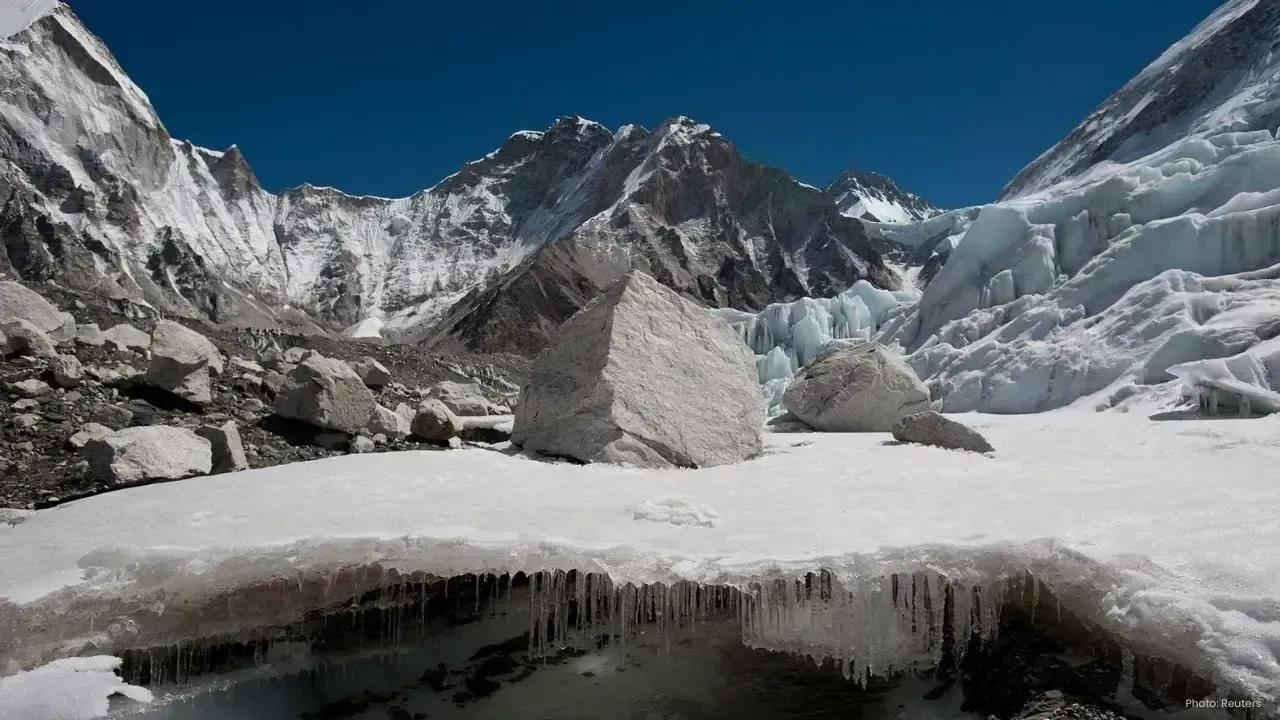
Winter snow accumulation in the Himalayas has drastically decreased, leaving numerous peaks stark and exposed this season, contrary to their usual snowy appearance, meteorologists report. Data from the last five years indicates a consistent drop in snowfall below the historical averages from 1980 to 2020.
Increasing temperatures are leading to quicker melting of the little snow that does fall. Lower-altitude areas are experiencing more rainfall instead of snow, a phenomenon partly blamed on climate change. This developing pattern is being termed a “snow drought” impacting vast sections of the Himalayan region.
The rapid glacier melt caused by rising temperatures has long raised alarms for India’s Himalayan states and their neighbors. Experts alert that dwindling winter snowfall is exacerbating this crisis. The reduction of snow and ice not only alters the mountains' landscape but also affects millions and fragile ecosystems that depend on these vital water resources.
In the spring, the winter snowpack melts, nourishing rivers that supply drinking water, irrigation, and hydropower. Decreased snowfall heightens the risk to this critical supply. A fall in winter precipitation also raises the chances of forest fires in drier conditions.
Snow and glaciers provide essential stability to the mountainous terrain. Their absence leads to increased occurrences of natural disasters such as rockfalls, landslides, glacial lake outbursts, and debris flows.
Meteorologists stress that this drop in snowfall isn’t an isolated incident. The Indian Meteorological Department has reported nearly no rain or snow across northern India in December. From January through March, northwestern regions—including Uttarakhand, Himachal Pradesh, Jammu, Kashmir, and Ladakh—are projected to receive up to 86% less precipitation compared to long-term averages.
The long-term average (LPA) assesses rainfall and snowfall over three to five decades to categorize current weather conditions as normal, excessive, or insufficient. The LPA for north India from 1971 to 2020 was recorded at 184.3 millimeters.
“This decline in winter precipitation is evident across numerous datasets,” stated Kieran Hunt, a leading research fellow in tropical meteorology at the University of Reading, UK. His study from 2025 spans from 1980 to 2021 and identified a significant drop in winter precipitation in the western and central Himalayas.
Using ERA-5 reanalysis datasets, Hemant Singh, a researcher at the Indian Institute of Technology in Jammu, reported that snowfall in the northwestern Himalayas has decreased by 25% over the past five years when compared to the 1980-2020 average.
Nepal, which is home to the central Himalayas, has also registered notable declines. “Almost no rainfall has been recorded since October, and it appears this winter will remain predominantly dry. This trend has persisted for the last five years,” noted Binod Pokharel, an associate professor at Tribhuvan University in Kathmandu.
While some winters have seen heavy snow in localized areas, these events are sporadic and not reflective of the consistent, even distributions of snowfall experienced in past decades, meteorologists pointed out.


 English