Post by : Meena
Hassan
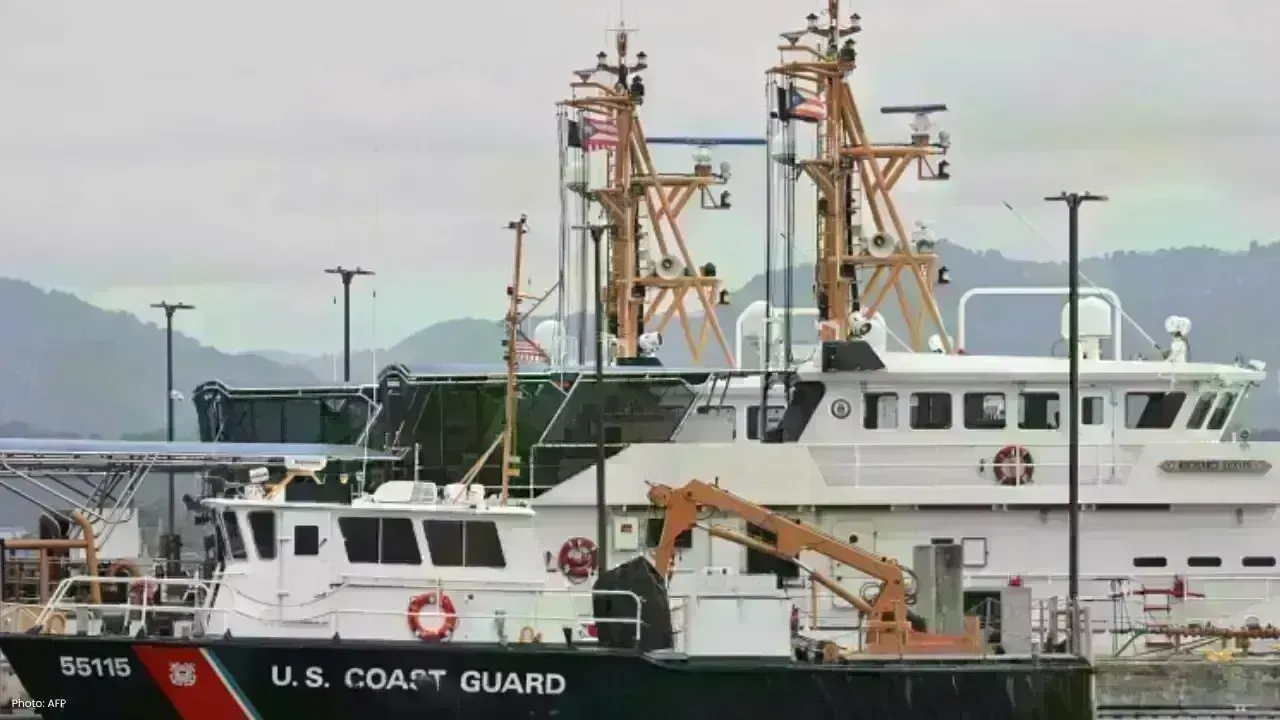
The US Coast Guard has officially ended its search for survivors after US military strikes on several boats in the eastern Pacific Ocean raised significant legal and human rights concerns regarding the operations.
An update published on Friday revealed that the search lasted three days, covering an area approximately 400 nautical miles from the Mexico–Guatemala coastline. Rescue crews reported no sightings of survivors despite over 65 hours of operations.
Challenging weather conditions, including nine-foot waves and winds near 40 knots, hampered search efforts, causing visibility issues.
Earlier, the US military's Southern Command confirmed strikes on three boats in the region. Reports indicate three fatalities on one boat, while those aboard the other two vessels jumped into the ocean before being struck and subsequently sinking. Additionally, two more deaths occurred during a separate strike, the specific location of which was not disclosed.
The military asserted that the target vessels were involved in drug trafficking, although no evidence has been released to support this claim.
These incidents represent a total of 33 confirmed US strikes on maritime vessels since early September, leading to at least 115 fatalities, according to the Trump administration.
The Coast Guard did not clarify how many individuals may have been in the water during the search. Military officials indicated that the Coast Guard was called in promptly, as no US Navy ships were nearby. Aircraft were dispatched from California, and regional vessels were advised to assist as needed.
Human rights organizations and international law experts have expressed strong criticism regarding these strikes, arguing they may constitute extrajudicial killings conducted without judicial oversight and could violate maritime and humanitarian laws.
Defending the strikes, the Trump administration labeled the targets as “narcoterrorists” purportedly using drug trafficking to pose a threat to US national security.
Public scrutiny grew following a prior strike in the Caribbean that appeared to hit survivors from an earlier attack, raising concerns about compliance with military engagement rules and applicable laws of armed conflict.
Dramatic past cases have shown some survivors do emerge from similar strikes. In late October, a Mexican Navy rescue operation was called off after four days. In another instance, two survivors found from a sunken boat in the Caribbean were returned to their countries, with one individual released by Ecuadorian authorities due to insufficient evidence against him.
Most recent US military activities have focused on waters around Venezuela, coinciding with Washington’s efforts to tighten economic sanctions, amplify military presence, and restrict sanctioned Venezuelan oil shipments.
In response, Venezuelan President Nicolás Maduro accused the US of attempting to destabilize his government and seize control of oil reserves, although he has recently taken a more tentative approach, showing readiness to engage in discussions with the US concerning drug trafficking.


 English