Post by : Anis
Al-Rashid
Escalating Tensions Over Shaksgam Valley
In early 2026, the Shaksgam Valley dispute has flared up again with China publicly asserting its claims on the region. This move has elicited strong responses from India, attracting international scrutiny due to the historical context of boundary conflicts that have significant implications for regional security and strategic initiatives. The renewed tension is further fueled by China's vigorous defense of its infrastructure projects in the area, intensifying a complex diplomatic landscape involving India, China, and Pakistan.
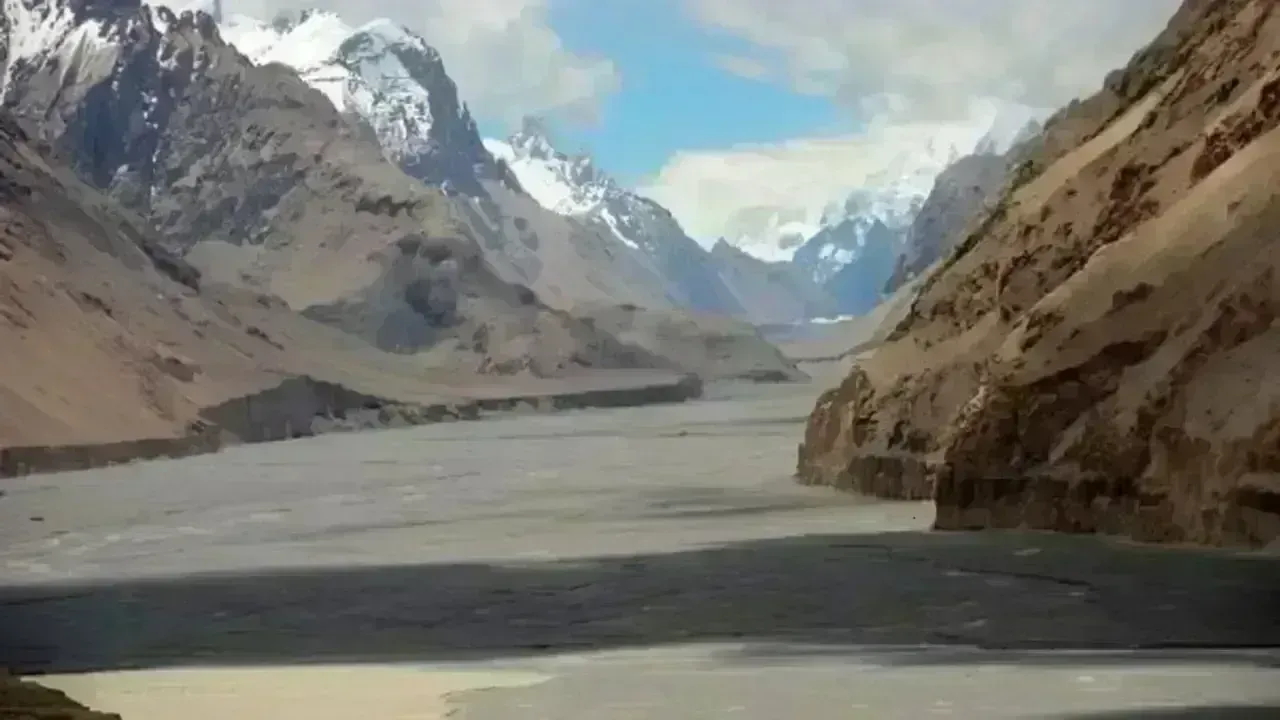
Known as the Trans-Karakoram Tract, the Shaksgam Valley is located in a high-altitude region north of the Siachen Glacier within the Karakoram mountain range. Although under Chinese administration, India insists that it remains a crucial part of its territory—a claim grounded in historical treaties and legal contexts. This article explores the origins of the conflict, its strategic importance, the positions of involved parties, and the broader geopolitical repercussions.
Strategic Significance of Shaksgam Valley
Geographical Overview
Located at the northern outskirts of what India claims as its territory in Jammu and Kashmir and Ladakh, the Shaksgam Valley runs along the Shaksgam River, a tributary of the Yarkand River, and is flanked by the Karakoram and Kunlun mountain ranges. Despite its inhospitable terrain and sparse population, its geographical position grants it noteworthy strategic value, particularly adjacent to the contested Siachen Glacier and various key international corridors affecting military and economic maneuvers.
The valley's significance is heightened by its association with the China-Pakistan Economic Corridor (CPEC), designed to link China's Xinjiang with Pakistan's Gwadar Port. Control over these routes not only provides tactical advantages but also symbolizes major shifts in regional power dynamics.
Historical Context: Claims and Treaties
Situation Before 1947
Prior to the 1947 partition of British India, the Shaksgam Valley was part of the princely state of Jammu and Kashmir. After the partition and the consequential Indo-Pakistani conflicts, parts of this area came under Pakistani governance, setting the stage for future negotiations and disputes among India, Pakistan, and China.
1963 Agreement Between China and Pakistan
The crux of the ongoing dispute lies in the 1963 boundary agreement between China and Pakistan, where Pakistan ceded control of the Shaksgam Valley to China, conditional on the Kashmir issue being resolved. India has consistently dismissed this agreement as invalid and illegal, maintaining that Pakistan lacked the authority to cede territory that it claims under internationally recognized jurisdiction, following its accession to India in 1947.
Current Dynamics: China's Reassertion and India's Firm Stance
China's Recent Claims
Earlier this year, Chinese officials reaffirmed their claims to the Shaksgam Valley, declaring the area legitimately within their sovereignty while justifying ongoing infrastructure developments in the region. This followed India's diplomatic protests concerning these activities, positioning the construction efforts as key to local development and connectivity.
India's Legal and Diplomatic Claims
In contrast, India maintains its claim over the Shaksgam Valley, rejecting any recognition of the 1963 agreement. Government representatives emphasize that any territorial transfer without India's consent is unlawful. The Indian Ministry of External Affairs reaffirmed that all territories, including Kashmir and Ladakh, are integral to India, underscoring this with military readiness along the Line of Actual Control (LAC).
Pakistan's Role: Ceding Territory for Strategic Gains
Pakistan occupies a delicate position in the Shaksgam Valley dispute, partly owing to the 1963 boundary agreement aimed at strengthening ties with China post-1962 Sino-Indian War. By ceding the valley, Pakistan gained strategic collaboration with Beijing, viewing it as a counterbalance against India. Subsequent support for China’s territorial claims has further complicated the resolution of disputes in the region.
Military and Security Implications
Geostrategic Considerations
The Shaksgam Valley’s importance extends beyond territorial contestation and into military strategy. Its location relative to the Siachen Glacier—an area of significant military presence for India—and its connections to the Karakoram Pass underscore its value in defense strategy. Control over the valley is crucial for monitoring logistics and troop movements across adjacent territories.
Broader Geopolitical Consequences
Complex India-China Relations
This dispute highlights the strained relations between India and China. Despite recent attempts to ease tensions along the Himalayan border through agreements, unresolved territorial issues continue to challenge the establishment of sustainable peace. The overlapping claims in the region complicate negotiations further.
Impacts on Regional Dynamics
The Shaksgam Valley issue represents competing motivations among India, China, and Pakistan: India emphasizes territorial integrity, China focuses on strategic expansion, while Pakistan aligns itself with China to gain leverage. Regional and global security interests intertwine as the disputed area influences broader geopolitical frameworks, with initiatives like CPEC adding layers of complexity.
Wrap-Up: A Complicated Legacy
The ongoing Shaksgam Valley dispute underscores how historical agreements, geographic considerations, and strategic objectives intertwine, keeping this regional conflict alive. China's reassertion and India’s firm response highlight the enduring challenges each nation faces regarding security, sovereignty, and geopolitical significance.
Disclaimer:
This article provides a synthesis of publicly available information for informational purposes and does not reflect any government's official stance.


 English