Post by : Saif
Al-Najjar
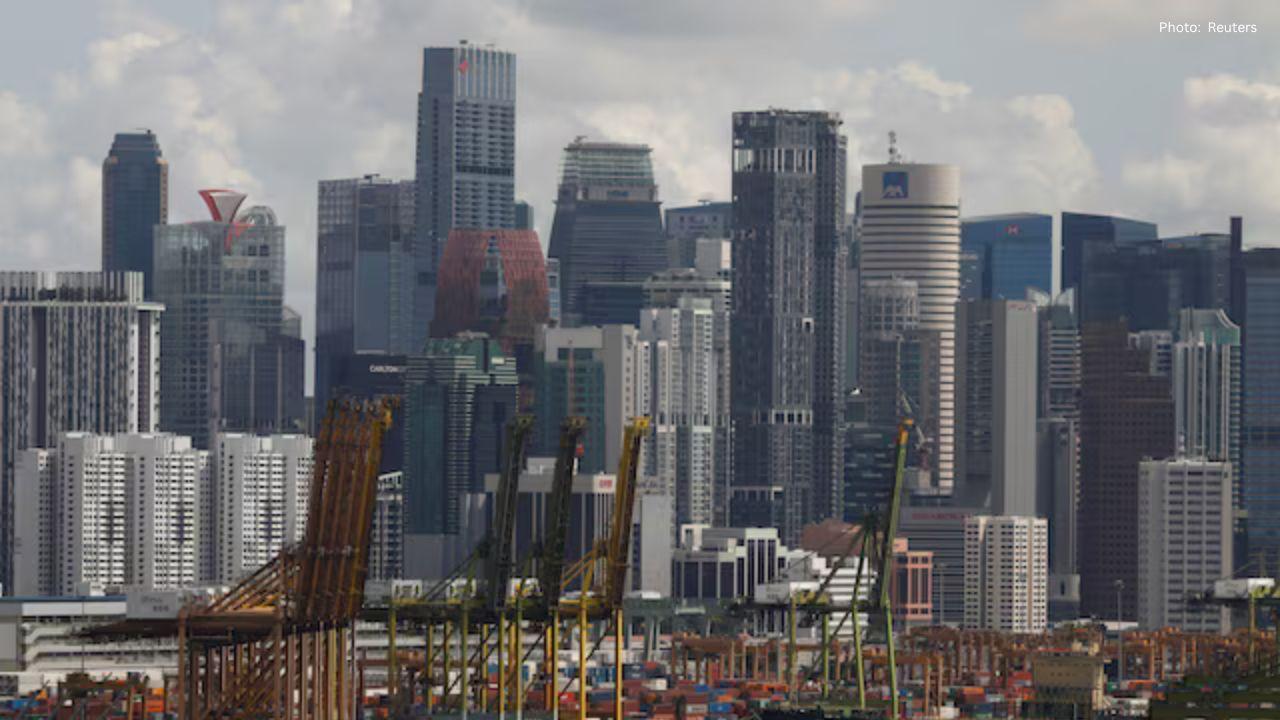
According to a recent survey from the Monetary Authority of Singapore (MAS), economists have become increasingly optimistic about Singapore's economic growth for 2025. This is largely influenced by positive economic indicators seen recently. However, they caution that growth may decelerate in 2026 due to rising global risks.
The MAS survey, conducted in the final quarter of the year with insights from 20 economists, reveals that the median growth forecast for 2025 has improved significantly to 4.1%, up from a previous estimate of 2.4%. This increase reflects better-than-anticipated performance in the economy over the past months.
Data shows that Singapore's economy expanded by 4.2% in the third quarter year-on-year, surpassing initial estimates and elevating economists' confidence. Additionally, in November, the trade ministry upgraded its official growth forecast for 2025 to around 4.0%, reinforcing this positive sentiment.
While the outlook for 2025 is robust, economists anticipate a slowdown in 2026, projecting growth to drop to approximately 2.3%. This expectation stems from concerns of weaker global demand and potential waning momentum in key growth sectors like trade and technology.
The survey also identifies several risks that could impact Singapore's economy, with many economists highlighting escalating geopolitical tensions as a significant downside risk. Given Singapore's status as a small, open economy, it is particularly vulnerable to global conflicts, trade issues, and supply chain disruptions.
Furthermore, worries about a possible burst of the artificial intelligence bubble have emerged, with about 40% of economists mentioning this concern—an issue not raised in previous surveys. While AI has fueled substantial investment and optimism in tech, economists warn that abrupt changes in investor sentiment could adversely affect growth.
Conversely, a thriving AI-driven technological sector coupled with stable global growth could further bolster Singapore's economy. Should global demand stay strong, Singapore may see benefits in trade, investment, and innovation.
In terms of monetary policy, economists foresee continuity. All participants agree that the MAS is unlikely to alter its policy during the upcoming January review. Most also predict no changes at the April meeting, with only about 11% anticipating a potential tightening by July 2026.
Inflation forecasts appear steady for the near term. Economists anticipate core inflation and headline inflation for 2025 will remain stable at 0.7% and 0.9%, respectively. Projections indicate slight increases in inflation for 2026, with estimates for core inflation at 1.3% and headline inflation at 1.5%.
These forecasts align well with MAS's own expectations, which indicated in October that core inflation is expected to average around 0.5% in 2025, while headline inflation should stay between 0.5% and 1.0%.
In conclusion, the survey presents a cautiously optimistic outlook for Singapore’s economy in 2025, underpinned by significant growth and stable policies. Nevertheless, economists emphasize the importance of monitoring global risks and challenges to secure sustained long-term stability.


 English