Post by : Mariam
Al-Faris
Photo: WAM
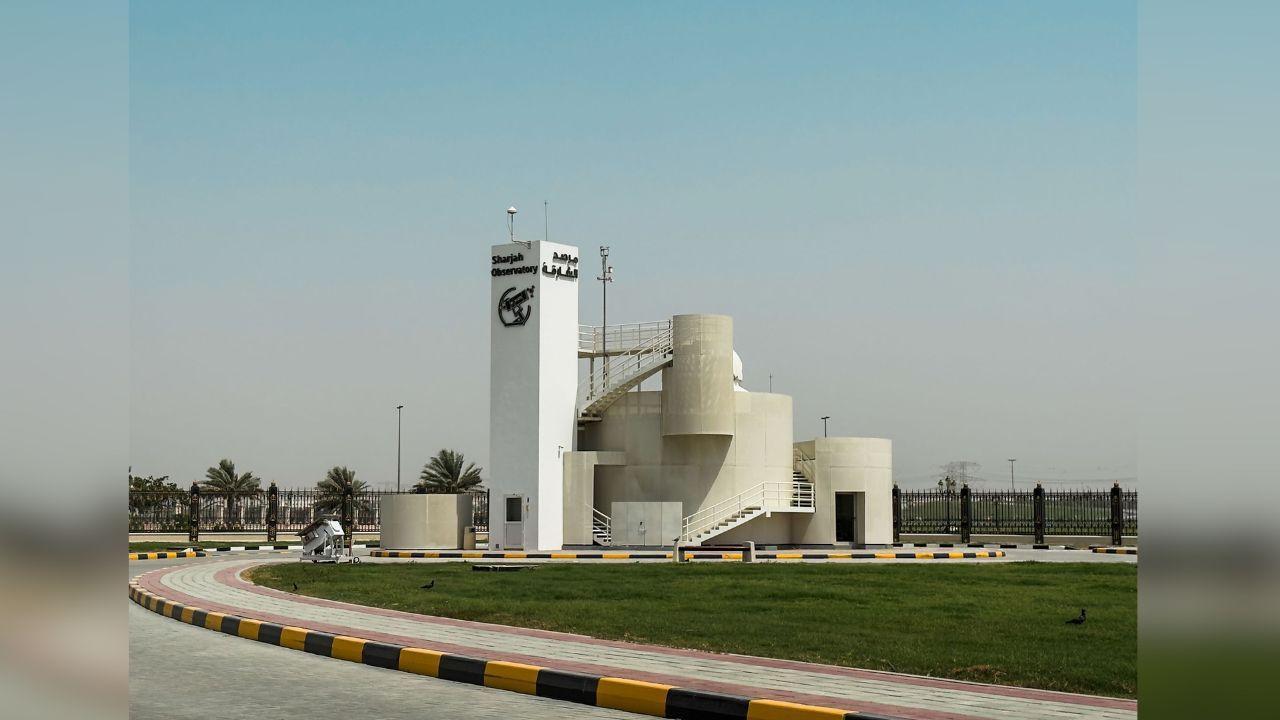
The Sharjah Academy for Astronomy, Space Sciences, and Technology (SAASST), which is part of the University of Sharjah, has done something amazing. They used their Sharjah Astronomical Observatory (SAO) to watch a rare and difficult space event.
This event was very important in the world of astronomy, and it was hard to see, but the team in Sharjah did it successfully. Many scientists around the world tried to watch it, but only a few were able to do it—and Sharjah was one of them. This is a great achievement for the UAE and shows that the country is growing in space science.
What Did They See in the Sky?
The event they watched is called a “stellar occultation.”
This happens when an asteroid (a big space rock) moves in front of a star and blocks the star’s light for a few seconds. It is like a small eclipse. You are looking at a star, and suddenly it disappears for a moment because something came in front of it.
This may look like a small event, but for scientists, it is very useful. It helps them study the asteroid and understand its size, shape, and other features.
The asteroid’s name is Quaoar.
The asteroid that blocked the star is called Quaoar.
Here are some simple facts about Quaoar:
-
It is very far from Earth, over 6.5 billion kilometers away.
-
It belongs to a group of space objects called Trans-Neptunian Objects (TNOs), which are far beyond the planet Neptune.
-
Quaoar is about 1,110 kilometers wide, which is huge—almost the size of a small country.
-
It moves around the Sun in a big round path and takes many years to complete one orbit.
Because it is so far and small, it is very hard to study. That’s why this event was a great chance for scientists.
The Star Disappeared for 45 Seconds
During this event, Quaoar moved in front of a star and blocked its light for 45 seconds.
This may seem short, but for an event like this, 45 seconds is a long time. In those few seconds, scientists can learn a lot about Quaoar by watching the way the light disappears and returns.
They use this data to understand
26 Observatories Tried to Watch It
Because this event was so special, 26 observatories (places with large telescopes) from different countries tried to watch it.
All these teams set up their equipment in different locations, hoping they would be in the right spot to see Quaoar block the star.
But many were unlucky. Some had bad weather, and some were not in the correct path. Only a few could see it—and Sharjah was one of the lucky ones.
Why Sharjah Succeeded
The Sharjah Astronomical Observatory was in just the right place to see the shadow of Quaoar pass by.
Here’s why they succeeded:
-
Their location was perfect—right in the middle of the shadow path.
-
The weather was clear with no clouds.
-
Their equipment was very accurate and well-prepared.
-
Their team worked hard and made sure everything was ready at the exact time.
Because of this, Sharjah was able to record the full event clearly—from the start to the end.
Why This Event Was So Hard
This event was very difficult to observe for many reasons:
-
The star that was blocked was very dim (not bright), so it was hard to find.
-
The star was in a busy part of the sky, with many other stars, so it was easy to get confused.
-
The asteroid moved fast, so scientists had to watch at exactly the right time.
-
Only people in a narrow part of the Earth could see it—others were outside the shadow.
-
Bad weather could ruin everything—even one cloud at the wrong time.
That’s why only a few observatories in the world managed to see this—and Sharjah was among the best.
Why Is This Important?
You may ask, “Why does this matter?”
This event helps scientists:
-
Measure the size and shape of faraway objects.
-
Study if the asteroid has a thin layer of gas or rings.
-
Learn more about how the solar system works.
-
Understand how such objects formed billions of years ago.
These things help us learn about the history of space, and someday they might help in space travel or the discovery of new planets.
UAE’s Big Step in Space Science
This successful observation shows that the UAE is becoming a strong country in space science.
The Sharjah Academy for Astronomy, Space Sciences, and Technology is doing world-class work. Their team is using modern tools, good planning, and strong knowledge to study the universe.
This is a proud moment for the UAE. It shows the world that the country is ready to take part in big space projects.
Helping Students Learn
This event also helped students and young scientists at the University of Sharjah.
They got a chance to:
This kind of learning is better than books. It gives them real experience and helps them become future astronomers, engineers, and scientists.
A Special 45 Seconds
Those 45 seconds when the star disappeared may seem small, but they were very special.
They brought
-
New information about Quaoar
-
A success story for UAE science
-
A moment of pride for the Sharjah team
This event will be remembered as an important step in the UAE’s journey into space.


 English