Post by : Bianca
Haleem
While discussions surrounding Greenland are abundant, the main hurdle for U.S., NATO, and European ambitions is ice.
The thick, shifting Arctic ice obstructs harbors, closes coastlines, covers mineral deposits, and transforms nearby waters into treacherous zones for navigation. Without icebreakers, many regions around Greenland are largely unapproachable.
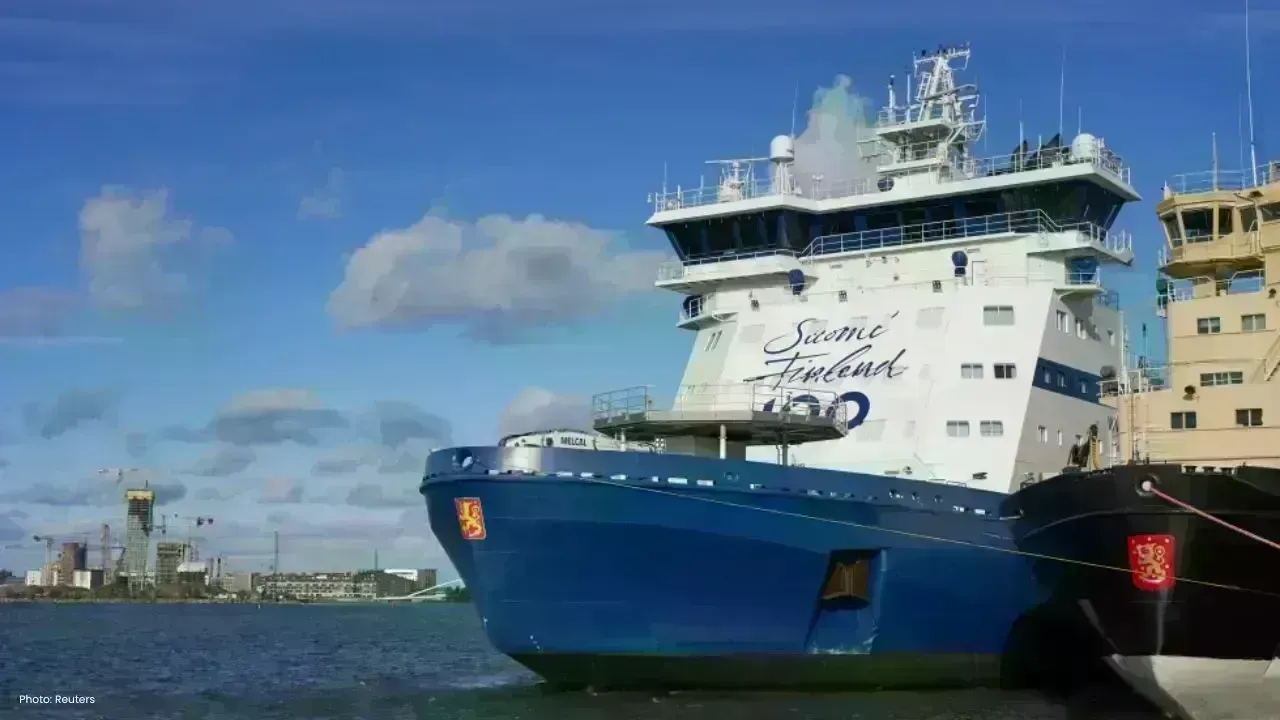
These robust vessels are designed to break through frozen seas, creating navigable routes where conventional ships would face disaster. However, as Arctic significance grows for global security and resources, the U.S. is alarmingly underprepared.
America’s Arctic Limitation
Currently, the U.S. has only three operational icebreakers, with one being nearly obsolete. In contrast, Russia boasts nearly 100 ice-capable ships, including nuclear-powered ones. Canada aims to increase its fleet to 50, while China already surpasses the U.S. in icebreaker numbers and is rapidly expanding its capabilities.
The U.S. government has committed to procuring 11 additional icebreakers, yet even optimistic projections indicate years before these vessels become operational.
“If the U.S. attempted to transfer significant supplies to Greenland, there would be a two- to three-year period during which the island would remain largely inaccessible,” commented Alberto Rizzi from the European Council on Foreign Relations.
“Greenland might look surrounded by water on maps, but it is truly encircled by ice.”
The Importance of Greenland
President Trump has highlighted Greenland's strategic importance for U.S. security and economic interests. Its location is crucial in the Arctic and it hosts significant mineral reserves, such as rare earth elements essential for modern technologies and defense systems.
At a recent World Economic Forum in Davos, Trump noted that accessing these minerals would necessitate drilling through “hundreds of feet of ice.”
Experts assert that achieving this will be unrealistic without a dependable fleet of icebreakers to maintain supply routes, support mining operations, and safeguard military outposts.
Even ambitious defense projects, like the proposed $175 billion “Golden Dome” missile defense initiative, would face severe logistical challenges without consistent Arctic access.
Limited Builders
The U.S. has restricted options for acquiring new icebreakers, as only a few countries possess the capabilities to build them: Russia, China, Canada, and Finland.
Finland, in particular, excels in this area, having constructed around 60% of the world’s icebreakers and designing nearly half of the remaining vessels. Their edge comes from years of experience in the frigid Baltic Sea.
“These are very specialized abilities,” Rizzi noted. “Finland has transformed a necessity into strategic economic leverage.”
Canada also plays a vital role, while China is advancing its own polar fleet capabilities.
Ice Pact and Cooperation
During Trump's administration, the U.S. accelerated icebreaker production, a trend that continued under President Biden with the Ice PACT agreement alongside Canada and Finland.
As per the agreement, eleven icebreakers are set to be constructed; four in Finland and the remainder at U.S. and Canadian shipyards using Finnish designs.
However, rising diplomatic tensions concerning Greenland and trade disputes have strained this collaboration, despite experts asserting that the U.S. lacks feasible alternatives.
“Cooperation is essential for making this achievable,” affirmed Sophie Arts from the German Marshall Fund. “Currently, the U.S. cannot pursue this independently.”
The Price of Arctic Ambition
Even with adequate icebreakers, transforming Greenland into a significant mining or military center would incur substantial costs. Building infrastructure in one of the world’s harshest environments is a daunting task, with returns on investment potentially taking decades.
“Costs in the Arctic are always higher—transportation, construction, maintenance, and security,” Arctic expert Marc Lanteigne stressed. “Progress is slow in that region.”
Nonetheless, Denmark and other European partners have expressed willingness for enhanced collaboration, provided that sovereignty is acknowledged.
Danish Prime Minister Mette Frederiksen endorsed the enhancement of Arctic security, including initiatives led by the U.S., as long as it respects their territorial sovereignty.
Control of Arctic Access
Despite political rhetoric, one undeniable truth remains: Europe, particularly Finland, holds the technical expertise needed for Arctic access.
European Commission President Ursula von der Leyen underscored this stance, indicating that Finland is actively engaging in icebreaker sales to the U.S.
“This underscores that Arctic security can only be achieved collectively,” she stated.
Following a recent emergency summit in Brussels, the European Union announced increased defensive investments in Greenland, including new icebreakers.
The Icy Reality
Without a modern fleet of icebreakers, U.S. aspirations in Greenland remain largely speculative.
Minerals remain untapped. Military bases cannot be properly supplied. Power projection is unattainable.
In the Arctic, tangible assets such as steel and engines outweigh mere political rhetoric—as of now, the U.S. is several years away from having the necessary resources.


 English