Post by : Saif
Al-Najjar
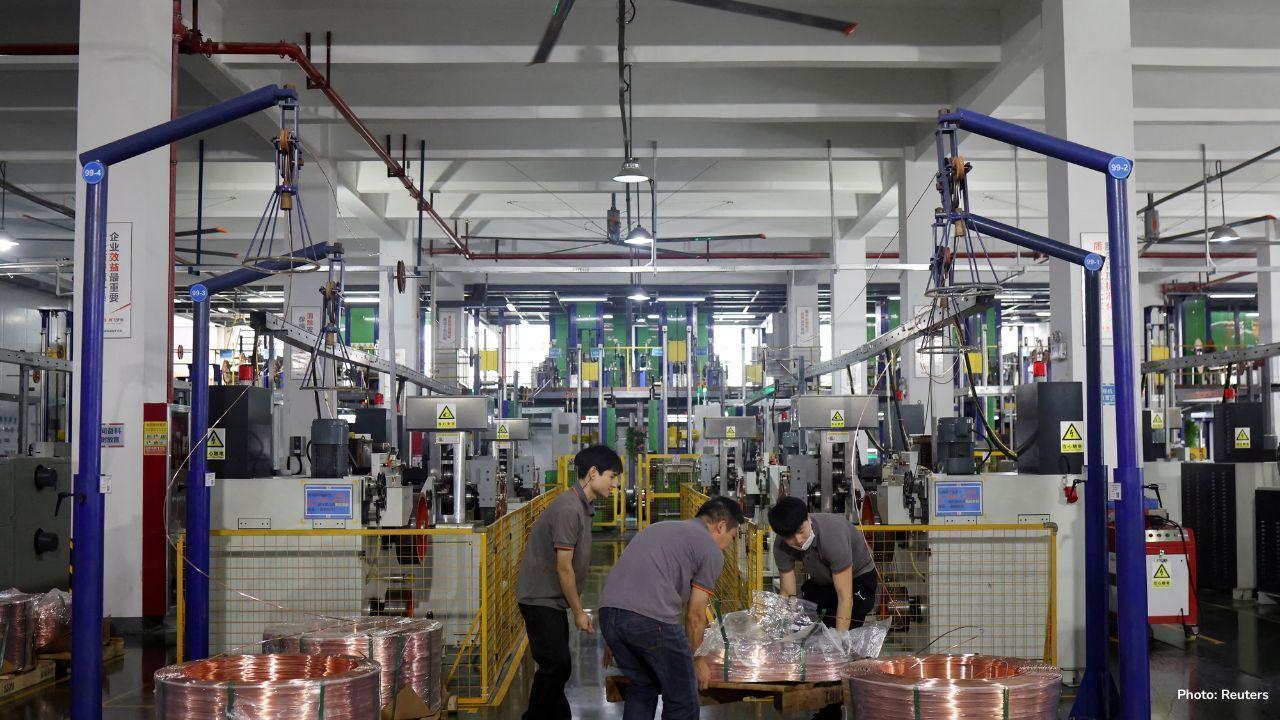
China’s factories are still facing hard times. In September, the country’s factory activity shrank for the sixth month in a row. This shows that the world’s second-largest economy is under pressure and waiting for help from the government as well as clarity on its trade deal with the United States.
What the Numbers Show
According to the official survey, China’s manufacturing purchasing managers’ index (PMI) rose to 49.8 in September, up from 49.4 in August. This was better than experts expected, but it is still under the 50 mark. A reading below 50 means factories are shrinking instead of growing.
The numbers show that demand inside China is still weak, even years after the pandemic. At the same time, U.S. tariffs under President Donald Trump have made life harder for Chinese producers and the foreign firms that buy from them.
A Different Survey Shows Growth
While the official PMI showed contraction, another private survey painted a more hopeful picture. The RatingDog General PMI, prepared by S&P Global, rose to 51.2 in September from 50.5 in August. This was the fastest growth since March.
This private survey showed that some factories, especially those focused on exports, received more new orders and boosted production. In other words, export-focused private companies are doing a little better than the large state-linked factories that depend more on local buyers.
Why the Difference?
The two surveys look at different groups of factories.
The official PMI, published by the National Bureau of Statistics, focuses more on large and medium-sized factories that sell mostly within China.
The private PMI covers a wider range of companies, including many smaller, private, and export-driven businesses.
That is why the official report showed weakness while the private survey showed modest growth.
Seasonal Support and Government Role
Xu Tianchen, an economist at the Economist Intelligence Unit, said the small rebound in the official PMI may be seasonal. He explained that summer disruptions are now over and that the government has started to give more support.
China’s economy often moves in waves: a strong start in the first quarter due to early stimulus, then slower growth midyear, followed by a pick-up near the end of the year when the government adds new measures to meet targets.
Non-Manufacturing Also Weakens
It is not only factories that are struggling. The non-manufacturing PMI, which measures services and construction, fell to 50.0 in September from 50.3 in August. This was the weakest result since last November.
The combined PMI, which includes both manufacturing and non-manufacturing, stood at 50.6 in September, almost the same as 50.5 in August. This shows that the whole economy is just barely holding steady.
Waiting for Stimulus and Trade Deal
Markets are now waiting for two things:
Government Stimulus – In August, the government introduced consumer loan subsidies to help people spend more. But these steps were small. Analysts believe more action may come soon, such as cuts to interest rates or bank reserve requirements.
Clarity on the U.S. Trade Deal – Businesses are still uncertain about trade relations with the United States. Tariffs on Chinese goods remain a heavy burden. Many firms want clear news on what direction trade talks will take.
Central Bank Stance
Pan Gongsheng, the governor of the People’s Bank of China, recently said the bank has many tools to support the economy. However, he did not cut interest rates like the U.S. Federal Reserve did.
Economists believe that before the year ends, China may lower interest rates by 10 basis points and also reduce the reserve requirement for banks by 50 basis points. This would allow banks to lend more money and support businesses.
Signs of Slowdown
Other data also showed that China’s economy is losing steam. In August, both factory output and retail sales grew at their slowest pace in 12 months. This means people are not buying as much, and companies are producing less.
Even though exports have shown some resilience and the stock market has improved, the broader economy still feels soft. Analysts describe this as the “soft underbelly” of China’s recovery.
Global Impact
China’s economy is very important for the world. If its factories slow down, countries that sell raw materials to China, such as Australia and Brazil, will also feel the impact. A weaker Chinese economy also reduces global demand for many goods, from electronics to cars.
At the same time, any improvement in China’s exports can help balance trade in Asia and beyond. That is why the world is closely watching both Beijing’s policy decisions and the progress of U.S.-China trade talks.


 English