Post by : Shweta
The anticipated launch of the SMILE mission in 2026 signals an urgent need to address a critical flaw in Europe’s space infrastructure: the disconnect between pioneering scientific advancements and outdated systems responsible for monitoring space weather. While European researchers gear up to deploy an advanced mission to explore Earth’s magnetic shield, the primary instruments for real-time solar storm alerts are relics from 1995, operating well beyond their intended life.
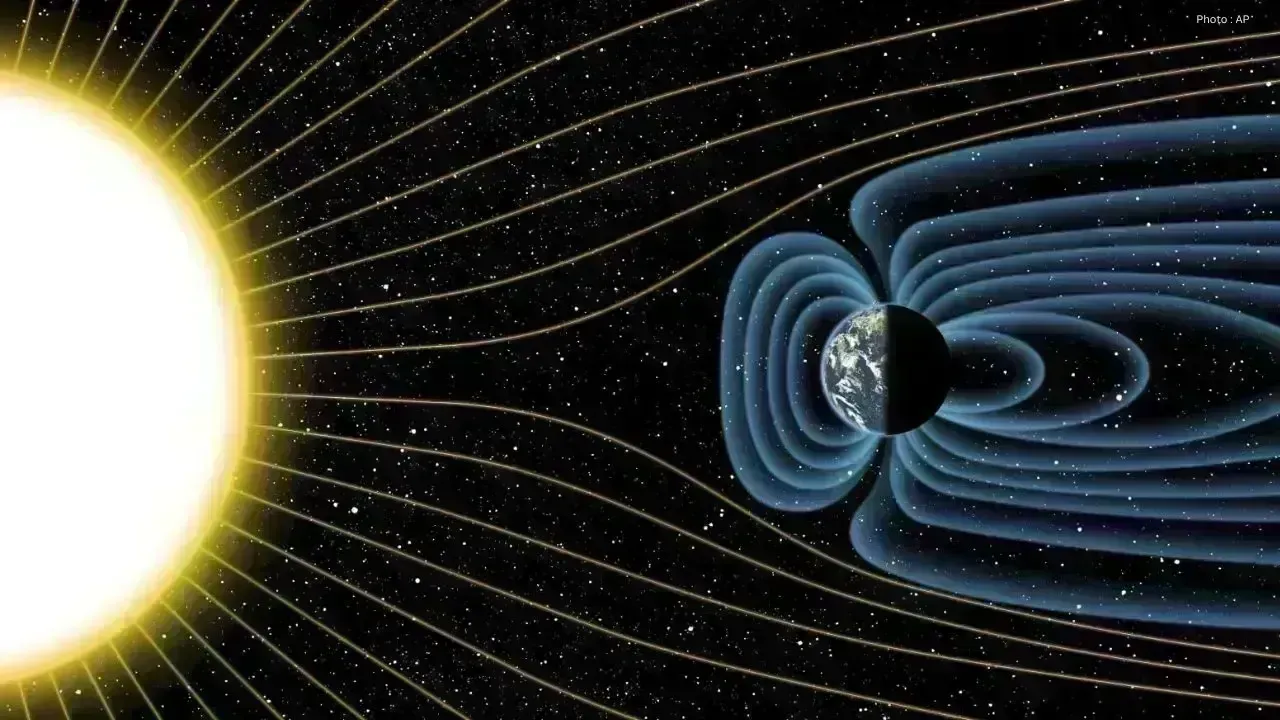
The SMILE mission, or Solar wind Magnetosphere Ionosphere Link Explorer, is a collaborative initiative between the European Space Agency and the Chinese Academy of Sciences. This spacecraft aims to provide intricate visuals of the interaction between solar wind and Earth’s magnetosphere, the shield that protects the planet from hazardous solar particles.
Experts anticipate that this mission could vastly improve our understanding of significant space weather phenomena, such as solar storms, which threaten satellites, communication networks, GPS systems, aviation routes, and power grids. This endeavor marks a notable advancement in heliophysics and space weather science, utilizing state-of-the-art imaging technology for unprecedented observations.
Nevertheless, space policy analysts caution that the enthusiasm surrounding the SMILE mission also brings to light a critical vulnerability. Europe, alongside various international forecasting networks, continues to heavily rely on aging satellites like SOHO, which was launched by ESA and NASA in 1995. Initially intended for a shorter operational period, SOHO has surpassed its expected lifespan by nearly three decades.
Despite its age, SOHO remains vital, offering insights into solar activity and supplying data that trigger alerts for potentially harmful solar storms. These warnings are becoming increasingly crucial as societies rely more on satellites, digital communication, navigation technology, and electrical grids that are susceptible to extreme space weather conditions.
Analysts emphasize that this predicament highlights a wider concern facing numerous space agencies: missions focused on scientific discovery often attract ample funding and international visibility, while essential long-term operational systems struggle to maintain steady financial support. In simpler terms, agencies may prioritize the development of groundbreaking research projects while their older, integral monitoring systems are left to deteriorate.
Experts alert that any degradation in operational solar monitoring could pose significant dangers to global infrastructure. A powerful geomagnetic event similar to those recorded in history could disrupt air travel, damage satellites, disrupt internet and communication services, and cause extensive power outages if monitoring systems fail or become inadequate.
ESA and various global partners are strategizing for future space weather monitoring systems, yet specialists assert that maintaining uninterrupted operational coverage presents both technical and financial challenges. Constructing replacement satellites, launching them, and ensuring consistent solar observation demand long-term coordination and ongoing investment.
The urgency of this issue has increased as governments and private entities expand satellite networks and space-based resources. Scientists note that the risk of solar storms to modern economies is much greater compared to when older satellites like SOHO were initially deployed.
As Europe embarks on groundbreaking missions such as SMILE, the contrast between leading-edge research initiatives and deteriorating operational systems becomes starkly apparent. Observers of space policy suggest that the key challenge is to balance scientific advancements with equally robust investments in dependable long-term monitoring solutions that safeguard critical infrastructure on Earth.


 English