Post by : Anis
Al-Rashid
A Unique Solar Phenomenon
In mid-January 2026, Earth faced one of the most powerful space weather events in recent history. The Sun released a massive solar radiation storm, rated at S4 (Severe) according to NOAA Space Weather Scales — a level not recorded since 2003. This substantial surge of high-energy particles, caused by intense solar activity, invaded Earth’s magnetic shield and elicited broad reactions in both space systems and the upper atmosphere.
Solar radiation storms are triggered when the Sun sends out bursts of charged particles, mainly protons, at high speeds. These energetic particles can breach Earth’s protective magnetic bubble and interact with its magnetic field and atmosphere, culminating in increased radiation levels. The January 2026 storm was sparked by a powerful X-class solar flare and an associated coronal mass ejection (CME), which is a massive cloud of plasma and magnetic fields expelled from the Sun's dynamic surface.
The significance of this event not only lies in its magnitude but also in its extensive visibility and potential ramifications. Space weather experts and monitoring organizations across the globe, including NOAA and ESA, are diligently tracking the storm as it evolves and interacts with Earth’s environment.
What Instigated the Storm?
Solar Flares and Coronal Mass Ejections
The January 2026 space weather event originated from a strong X1.9 solar flare erupting from a highly active region on the Sun. X-class flares represent the most potent category of solar flares, capable of emitting vast amounts of energy and propelling charged particles into space. Following the flare, a swift coronal mass ejection (CME) was propelled outward, carrying a substantial cloud of solar material.
These CMEs traverse through the solar system and, when directed toward Earth, can interact with our planet’s magnetic field. In this instance, the CME arrived remarkably fast, sparking intense geomagnetic activity and raising solar radiation levels in near-Earth space. This conjunction of solar activity has set the stage for a severe radiation storm.
An X-class flare combined with a CME is a recognized trigger for major space weather occurrences. When charged particles from a CME reach Earth’s magnetic field, they can induce disturbances, leading to what scientists refer to as geomagnetic storms. Intense interactions can create stunning visual phenomena and challenge technological systems.
Deciphering Solar Radiation Storm Levels
Solar radiation storms are categorized on a scale from S1 (minor) to S5 (extreme), based on the intensity of energetic particle fluxes. An S4 (Severe) rating indicates a highly intense occurrence where increased radiation can impact satellites, spacecraft, and aviation operations. The current storm, rated S4, marks the strongest event since similar occurrences in 2003.
This storm’s intense nature signifies real increases in energetic particles flowing through near-Earth space. Heightened radiation levels can have direct implications for humans and technology beyond Earth’s atmospheric barriers, especially in low-Earth orbit or on high-latitude flight routes.
Breathtaking Auroral Displays Worldwide
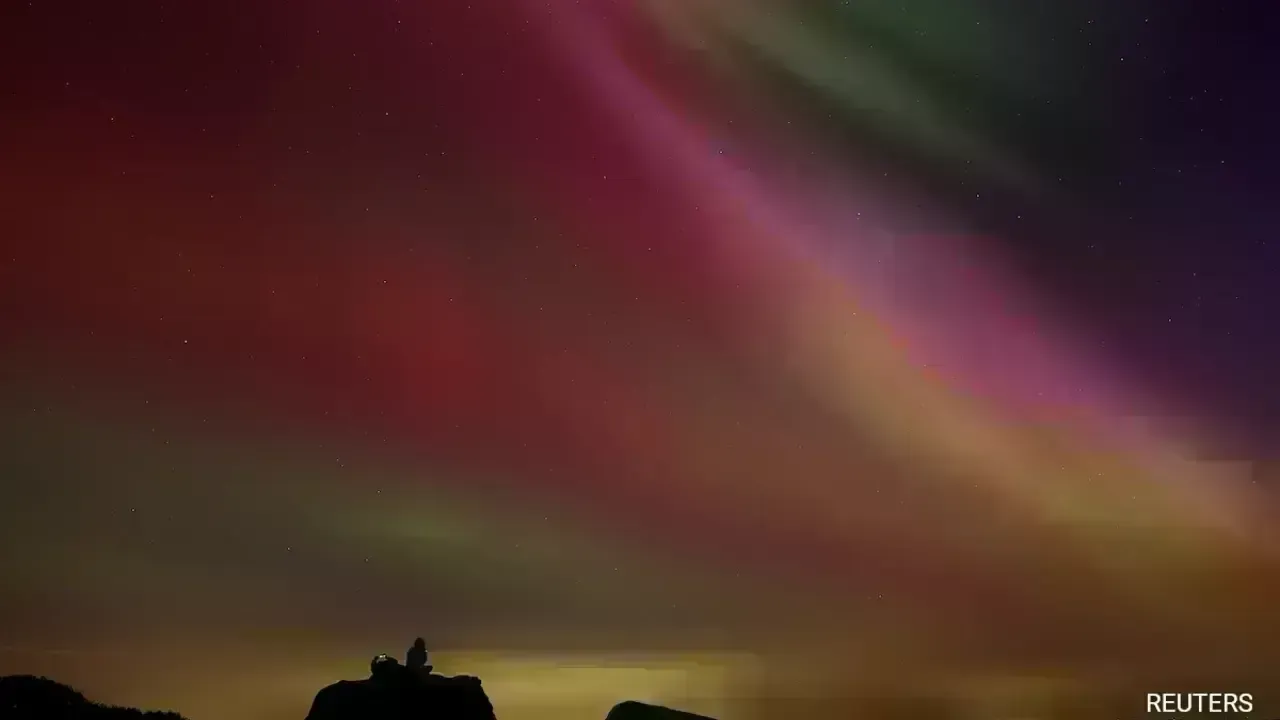
One of the most dramatic results of the solar radiation storm has been the appearance of auroras — Northern and Southern Lights — at latitudes well beyond their normal reach. Traditionally, these displays are restricted to polar regions but were observed over extensive areas of the United States, Europe, and even reaching mid-latitude territories.
Across the United States, observers witnessed vibrant green, red, and pink curtains of light illuminating the night sky as far south as California, Texas, and Alabama, where such sights are rare. Additionally, in Europe, individuals captured equally breathtaking views, while people in other locales, such as Ireland, experienced remarkable auroras that officials claim are historic and potentially once-in-a-lifetime displays.
In the Southern Hemisphere, the aurora australis (southern lights) also made unusual showings, with reports of visibility in areas of Australia and New Zealand that typically don't see significant auroral activity.
The extensive auroral activity occurs when charged solar particles travel along Earth’s magnetic field lines toward the poles, colliding with atoms and molecules in the upper atmosphere, producing a stunning light display. During intense geomagnetic disturbances, the auroral oval - the region where auroras can be seen - can extend to lower latitudes, providing extraordinary sights to observers worldwide.
Repercussions for Space and Technology
Impact on Satellites and Spacecraft
Though the visual effects of the storm have been awe-inspiring, the heightened radiation also poses risks to contemporary technology. Satellites orbiting Earth are particularly susceptible to increased levels of energetic particles, which can disrupt onboard electronics, degrade solar panels, and interfere with navigation and communication systems.
Space agencies and satellite operators are closely monitoring these effects. Safety measures, such as switching satellites into protective modes or adjusting their operational settings, are being employed to alleviate potential issues. For instance, precise navigation systems like GPS may experience temporary accuracy problems amid intense space weather conditions.
Aviation and High-Latitude Flight Routes
The storm also has repercussions for aviation, especially for flights traversing polar routes. At elevated latitudes, increased solar radiation can raise exposure levels for both passengers and crew. Additionally, it may disrupt high-frequency (HF) radio communications, primarily used in remote polar regions where alternative communication methods are less reliable.
Airlines and aviation regulatory bodies have been prompted to evaluate routes and communication protocols to ensure safety and uninterrupted operations. Although the risks might not directly threaten flight safety, they can affect operational efficiency necessitating meticulous management during severe space weather occurrences.
Historical Context: How Exceptional Is This Event?
Comparison with Past Solar Storms
Solar storms of this intensity are rare, though not entirely unprecedented. The Halloween storms of 2003 — often referenced in comparison to the current event — caused extensive geomagnetic activity, disrupted power systems, and produced striking auroras at lower latitudes.
Records of historical solar activity also include even more drastic events, such as the Carrington Event of 1859, which generated auroras around the globe and disrupted telegraph systems. While the January 2026 storm may not be on par with the Carrington Event’s intensity, it highlights the latent potential for significant space weather effects during peaks of solar activity.
Current analyses indicate that we are within the cycle of Solar Cycle 25, representing a phase of rising sunspot and flare activity. These cycles, spanning roughly 11 years, naturally yield intervals of heightened solar eruption frequency and intensity.
Scientific Monitoring and Observations
Researchers and space weather agencies are employing an array of satellites and ground-based instruments to scrutinize and interpret the solar storm’s development and impacts. Equipment onboard NOAA’s GOES satellites measures solar wind properties, particle fluxes, and magnetic field interactions, providing crucial real-time data to forecasters.
International collaboration among agencies, including the European Space Agency (ESA), ensures comprehensive data informs both scientific knowledge and practical readiness. Continuous monitoring helps reveal potential hazards, forecast auroral activity, and advise key infrastructure operators on expected consequences.
What Lies Ahead?
As the storm continues to develop, scientists will be vigilant for several critical indicators:
-
Whether solar wind conditions remain high and continue to drive geomagnetic activity.
-
How long elevated auroral visibility persists at lower latitudes.
-
Any further solar flares or CME occurrences that could prolong or escalate space weather effects.
Geomagnetic storms typically diminish over several days as Earth’s magnetic field stabilizes and solar wind conditions normalize. However, lingering effects may continue, especially with additional solar activities. Ongoing monitoring is crucial to assess both persistent impacts and potential hazards.
Disclaimer: This article is founded on available scientific observations and reports at the time of writing. The dynamic nature of space weather phenomena can cause rapid changes in conditions. For the latest updates, consult official space weather prediction agencies and scientific organizations.


 English