Post by : Saif
Al-Najjar
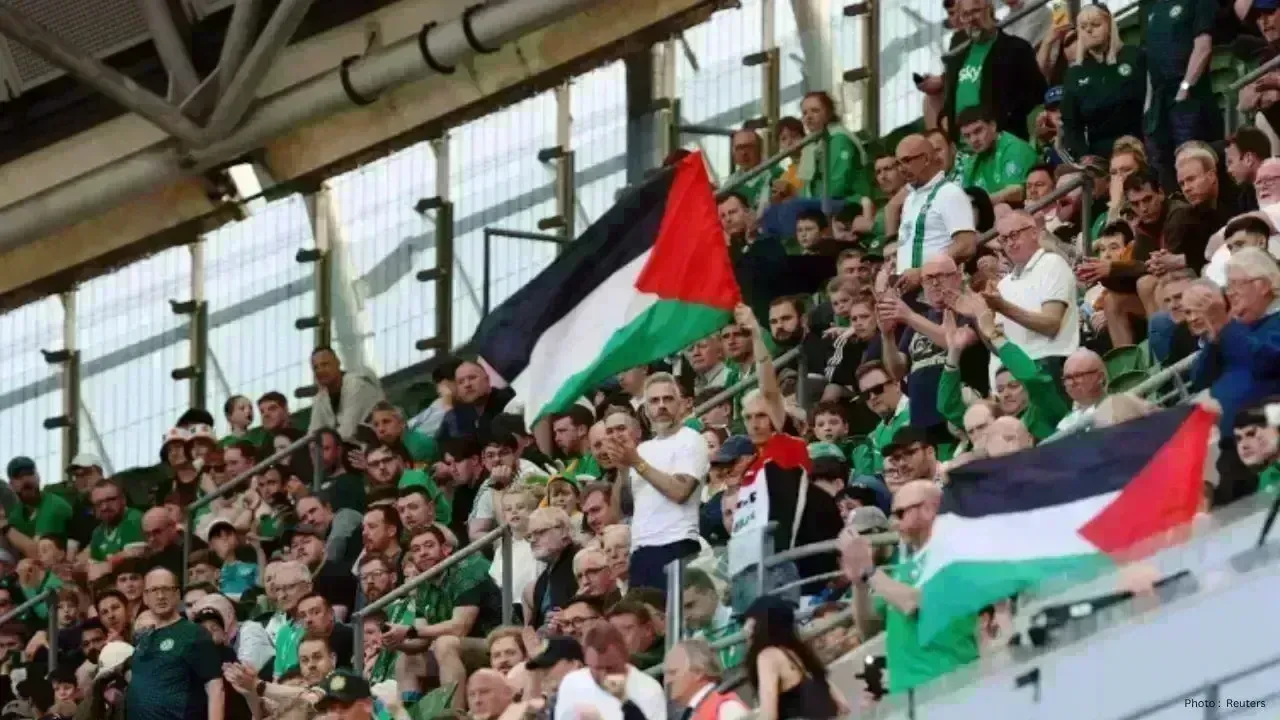
A protest at the Ireland vs. Qatar football match has drawn heightened focus on the escalating tensions intertwined with Israel and the influence of political activism in global sports.
This event has intensified scrutiny on football governing bodies as the conversation continues on the impact of political factors on international sports events and athlete engagement.
Protesters at the match displayed messages linked to the ongoing Israeli conflict, eliciting strong reactions from fans, officials, and analysts alike. This demonstration quickly caught the global spotlight, reigniting the debate on the appropriateness of political statements at sporting events.
Traditionally, football serves as a platform uniting individuals from diverse cultures and backgrounds. However, international matches are increasingly emerging as venues where fans and activist groups voice their political, social, and humanitarian concerns.
The recent protest signifies a growing chasm within global sports communities concerning Middle Eastern conflicts and the roles athletes, fans, and organizations play in political discourses.
Sports regulatory bodies typically strive to distance political activities from formal competitions. Organizations like FIFA and UEFA uphold regulations aimed at maintaining sports neutrality by preventing political messages during matches.
Conversely, activists maintain that sporting events inevitably reflect global realities and must engage with significant international issues.
The demonstration during the Ireland-Qatar match may prompt football organizations to revisit crowd control protocols, fan behavior policies, and guidelines on political expressions within stadiums.
Political conflicts linked to Israel have previously impacted a range of international sports events. Protests from athletes, demonstrations by fans, and calls for sanctions have repeatedly stirred controversy across various competitions.
The intertwining of sports and politics is pressuring governing bodies to navigate the balance between freedom of expression and ensuring order during international events.
As one of the most impactful sports globally, football garners millions of viewers. This vast audience means that political displays during matches usually attract substantial international media coverage.
Experts predict that future tournaments may need enhanced security measures and tighter monitoring if political protests become a regular occurrence at stadiums.
This recent incident might also raise diplomatic concerns for organizers overseeing multinational events, given the heightened political sensitivities in play. Event planners are increasingly tasked with preparing for demonstrations tied to global conflicts and humanitarian issues.
Supporters argue that athletes and fans should be entitled to express their views on critical global matters. In contrast, critics contend that the focus of sporting contests should remain on competition rather than on political issues.
The discourse surrounding political messages in football transcends one conflict or region. Similar controversies have arisen related to racism, human rights, violence, discrimination, and social justice within various global sports competitions.
International football authorities are expected to closely assess the latest issues as the demand grows for clearer rules regarding political expression with stadiums and during official matches.
The event during the Ireland-Qatar match illustrates how global political tensions are increasingly shaping the realm of sports. Football, once seen as solely entertainment and competition, is now interwoven with broader international dialogues on politics, identity, and public advocacy.
As reactions spring forth from fans, sports officials, and political entities, the debate over protests linked to Israel remains a pivotal issue.


 English