Post by : Raina
Al-Fahim
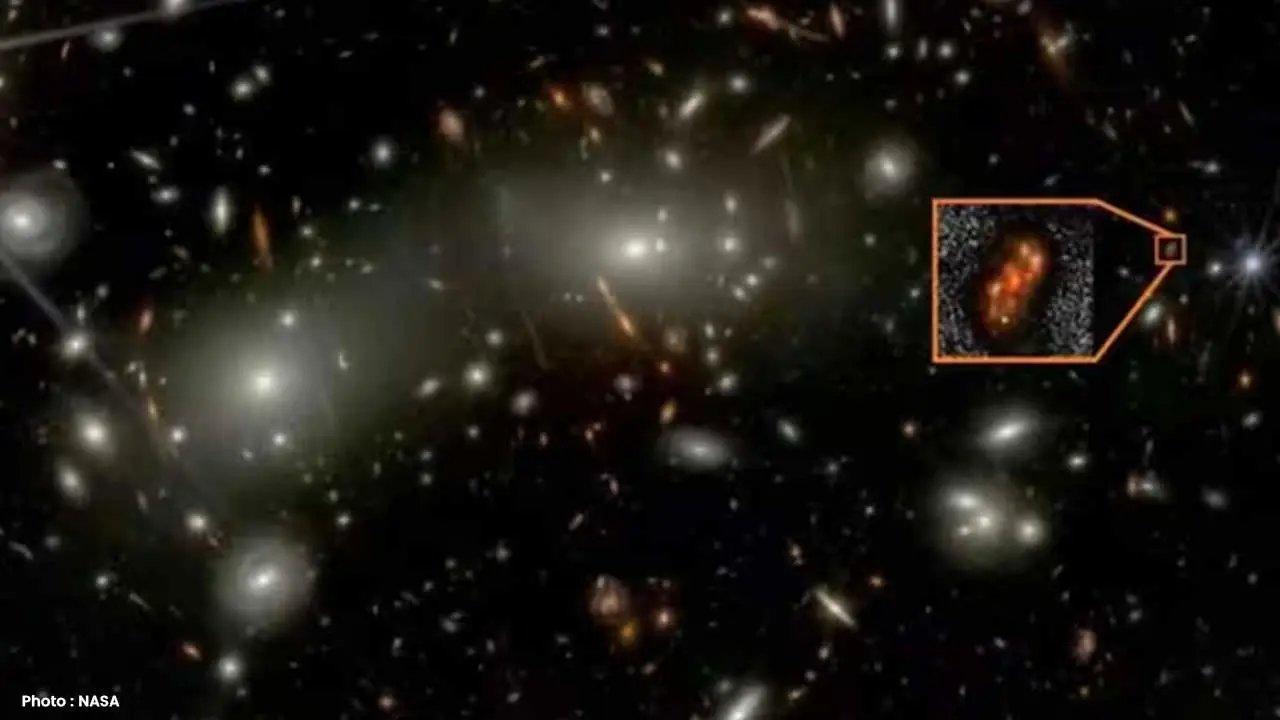
A team of astronomers in India has made a groundbreaking finding that alters the scientific community's understanding of the early Universe. With the aid of the James Webb Space Telescope (JWST), they discovered a large, fully developed spiral galaxy, existing just 1.5 billion years after the Big Bang, which is only about one-tenth of the Universe's current age of 13.8 billion years.
The discovery was led by Rashi Jain and her advisor, Prof. Yogesh Wadadekar, at the National Centre for Radio Astrophysics (NCRA-TIFR) in Pune, with results published in November in the European journal Astronomy and Astrophysics.
Named Alaknanda, after a river in the Himalayas, this galaxy astonished researchers, as early-universe galaxies were long assumed to be small and chaotic. Instead, Alaknanda showcases a stunning spiral structure, reminiscent of our Milky Way—an unusual finding for such ancient epochs.
Prof. Wadadekar commented that Alaknanda’s shape is “eerily similar to the Milky Way,” highlighting the rapidity with which this large spiral forming occurred within just a few hundred million years—truly extraordinary in cosmic timescales.
Spanning nearly 30,000 light-years, Alaknanda is about one-third the size of the Milky Way and boasts an estimated 10 billion stars. The team noted that it's forming new stars at a rate 20–30 times faster than our own galaxy today.
Jain initially identified the spiral structure while reviewing data from JWST, sifting through around 70,000 celestial entities. One galaxy, in particular, drew her attention due to its evident spiral formation, displaying the classic “beads-on-a-string” design with clusters of stars arranged along its arms—a rare pattern for early galaxies.
Upon sharing her discovery with Prof. Wadadekar, his immediate response was one of skepticism; the existence of such a mature galaxy so soon after the Big Bang challenges the conventional notion of galaxy formation being slow and disorganized during the Universe's early years.
Despite the plethora of galaxies in the Universe, previous expectations held that early galaxies would predominantly be small, faint, and irregular. However, Alaknanda serves as compelling evidence that the early cosmos was likely more developed and structured than once believed. Since JWST commenced operations, it has unveiled several ancient galaxies, but this particular find strongly suggests that complexity in galaxy formation occurred much sooner than previously accepted.
Because the light from Alaknanda has traveled 12 billion years to reach Earth, astronomers are essentially observing the galaxy's past. The galaxy's current state remains unknown, with Prof. Wadadekar stating, “To find out where it is now, you'll need to wait another 12 billion years.”
The research team is eager to carry out further observations with JWST or the ALMA observatory in Chile. They aim to explore how such a massive spiral galaxy formed its arms so early in the cosmic history. Gaining insights from galaxies like Alaknanda is expected to provide vital understandings of the Universe's past and answer pivotal questions regarding the evolution of galaxies into their current forms.


 English