Post by : Meena
Hassan
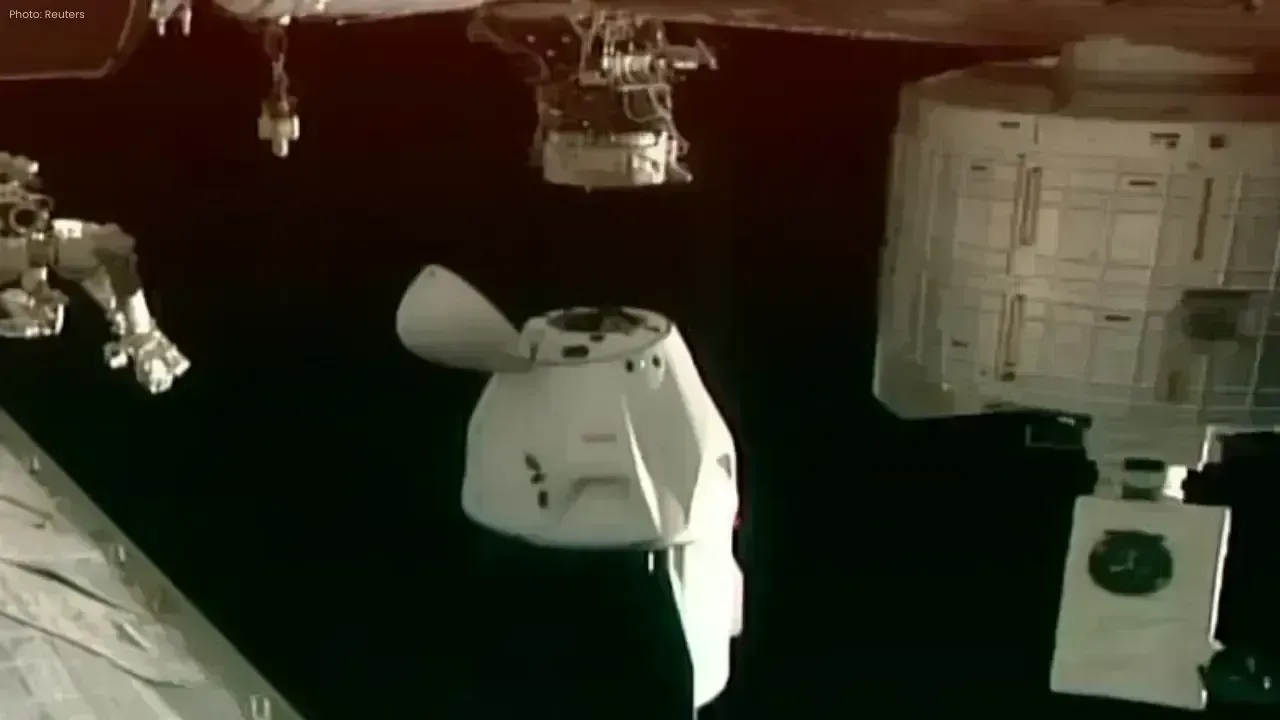
NASA’s Crew Dragon spacecraft Endeavour safely made its descent back to Earth early Thursday, splashing down in the tranquil waters off San Diego around 12:45 a.m. EST (0845 GMT). This landing came after a journey exceeding ten hours from the International Space Station, marking an unexpected early end to the mission due to a medical emergency involving a crew member.
As the capsule re-entered the Earth’s atmosphere, it experienced intense heat before decelerating for landing. Live infrared footage shared during a joint broadcast from NASA and SpaceX displayed two sets of parachutes deploying from the capsule's nose, effectively reducing its speed to approximately 25 kilometers per hour and allowing for a gentle splashdown in the Pacific Ocean.
Shortly after the capsule touched down, an unusual sight greeted the scene: several dolphins surfaced nearby, swimming around the upright Endeavour. Moments later, a message was relayed from inside the spacecraft. Commander Zena Cardman cheerfully informed mission controllers near Los Angeles, “It’s good to be home.”
Cardman, aged 38, was joined on the return journey by fellow NASA astronaut Mike Fincke, 58, Japanese astronaut Kimiya Yui, 55, and Russian cosmonaut Oleg Platonov, 39. The quartet launched together from Florida in August and spent 167 days on the space station. They departed the ISS on Wednesday afternoon and took about 10½ hours to return to Earth.
On January 8, NASA communicated that the crew would return earlier than scheduled due to a serious medical issue affecting one astronaut, necessitating immediate treatment on Earth. Officials opted not to disclose which crew member was impacted or the nature of the illness, adhering to medical privacy regulations.
Concerns had previously surfaced when a planned spacewalk by Cardman and Fincke was called off on January 7, which NASA attributed at the time to a medical concern involving an astronaut. The agency's Chief Health and Medical Officer later clarified that the situation was not related to any injury from mission activities.
The decision to bring all four astronauts home together underscores NASA’s commitment to crew safety. Space missions impose unique physical stresses on astronauts, and health complications not directly tied to mission activities can escalate rapidly in orbit. By truncating the mission, NASA enabled the affected astronaut to receive comprehensive medical evaluation and care on Earth.
The successful landing also showcased the dependability of SpaceX’s Crew Dragon system, which has successfully completed various crewed missions. Recovery teams swiftly approached the capsule post-splashdown to secure it and assist the astronauts, marking a safe closure to the mission despite its unforeseen early completion.


 English