Post by : Bianca
Haleem
Global oil prices remained above $100 per barrel on Monday as tensions in the ongoing Iran war continued to disrupt energy supply routes and create uncertainty in global financial markets.
A barrel of Brent crude, the international benchmark for oil prices, rose 2.5% to $105.70. Since the conflict began more than two weeks ago, Brent has surged over 40%. Meanwhile, U.S. benchmark crude increased 1.6% to $100.29 per barrel and has climbed nearly 50% during the same period.
The sharp rise in oil prices comes as Iran continues to launch drone and missile attacks targeting Israel, U.S. bases, and energy infrastructure in Gulf countries. In response to the attacks by the United States and Israel earlier in the conflict, Iran has effectively blocked cargo traffic through the Strait of Hormuz, one of the world’s most critical oil shipping routes.
The narrow strait normally carries around one-fifth of the world’s oil supply. However, tanker traffic has slowed dramatically, with only a handful of ships reported to have passed through the route in recent days.
According to energy research firm Rystad Energy, more than 12 million barrels of oil equivalent per day have been taken offline since the disruption began just over a week ago. The closure has forced several oil producers to cut output because their crude cannot be transported to international markets.
Analysts say the situation has created significant uncertainty in global markets. Stephen Innes of SPI Asset Management said much of the market is operating “in the fog,” noting that the strait typically handles around 25 oil and LNG tankers daily.
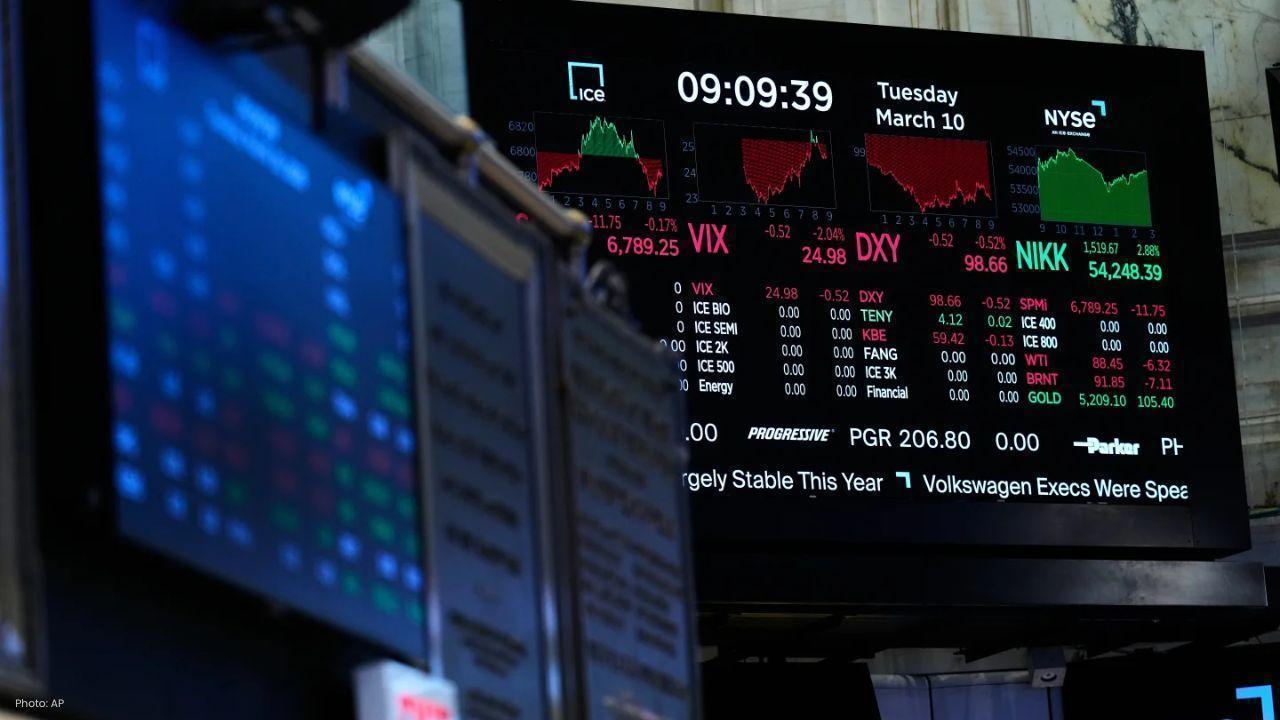
Global stock markets reacted with mixed performance as investors weighed the impact of higher oil prices on inflation and economic growth.
U.S. stock futures showed modest gains, with futures for the S&P 500 rising 0.6% and those for the Dow Jones Industrial Average up 0.5%.
In Europe, Germany’s DAX index slipped 0.1% to 23,423.51, while France’s CAC 40 declined 0.2% to 7,893.16. Britain’s FTSE 100 edged slightly higher, gaining 0.2% to 10,276.43.
Asian markets were also mixed. Japan’s Nikkei 225 dipped 0.1% to 53,751.15, while South Korea’s Kospi climbed 1.1% to 5,549.85. Hong Kong’s Hang Seng gained 1.5% to 25,834.02 after stronger-than-expected economic data from China for February. However, China’s Shanghai Composite index fell 0.3% to 4,084.79.
Australia’s S&P/ASX 200 dropped 0.4% to 8,583.40, while Taiwan’s Taiex declined 0.2%. India’s Sensex remained largely unchanged.
Last week, Wall Street closed lower as the surge in oil prices raised concerns about rising inflation. The S&P 500 fell 0.6% and is now down 3.1% for the year. The Dow Jones Industrial Average lost 0.3%, while the Nasdaq Composite declined 0.9%, marking the third straight weekly loss for both indexes.
The disruption in oil supply is raising fears of another wave of global inflation. If the conflict continues to affect production and transportation of oil from the Persian Gulf, energy prices could rise further and impact economies worldwide.
To stabilize markets, members of the International Energy Agency have released a record 400 million barrels of oil from emergency reserves. However, the move has done little so far to calm investors.
Higher inflation expectations are also complicating the U.S. Federal Reserve’s efforts to lower interest rates to support economic growth. The central bank is widely expected to keep rates unchanged at its upcoming policy meeting.
Recent economic data also shows inflation was already increasing before the latest spike in oil prices. According to the U.S. Commerce Department, consumer prices rose 2.8% in January compared with a year earlier. Core inflation, which excludes food and energy prices, increased 3.1%, the biggest rise in nearly two years.
Despite higher prices, consumer spending in the United States increased by 0.4% in January, matching the pace of income growth.
Meanwhile, revised data showed that the U.S. economy grew at a slow annual rate of 0.7% in the October-December quarter, partly affected by a 43-day government shutdown last fall.
In currency trading early Monday, the U.S. dollar weakened slightly to 159.34 Japanese yen from 159.55 yen, while the euro strengthened to $1.1441 from $1.1425.


 English