Post by : Saif
Al-Najjar
Latin America experienced a dramatic turn on Saturday when President Donald Trump announced that Venezuelan President Nicolas Maduro had been captured after U.S. military strikes overnight. This news has sparked fear and concern throughout Venezuela and its neighboring countries.
Trump stated that the United States executed extensive military actions aimed at Venezuela’s leadership. He claimed that Maduro and his spouse were apprehended and evacuated by U.S. forces, labeling the mission a success involving elite special operations in collaboration with American law enforcement. A comprehensive briefing was promised later.
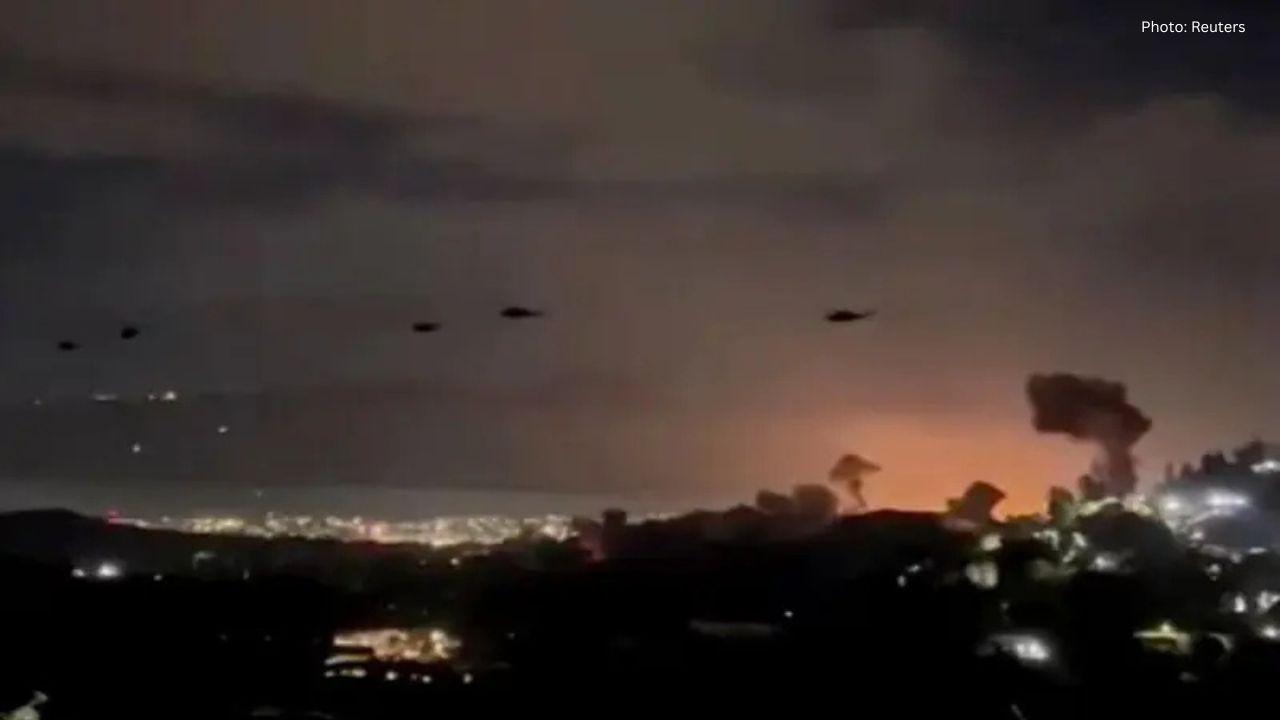
The strikes reportedly occurred in the early hours, with explosions reported across Caracas and surrounding regions. Residents documented the chaos, showing videos of billowing black smoke, helicopters in the air, and sudden bursts of light followed by loud blasts. Many citizens expressed fear and confusion due to the lack of clear information from officials.
While Maduro's capture remains unconfirmed by the Venezuelan government, Defense Minister Vladimir Padrino vehemently denied any presence of foreign troops. In a televised address, he asserted that Venezuela would resist what he termed an attack on its sovereignty, calling for unity among citizens and the military. He warned that foreign intervention only leads to suffering.
Many Venezuelans described a fearful night, hearing planes overhead and experiencing explosions. Some reported power outages near military sites. Citizens felt bewildered, relying on state media and social platforms for news.
The U.S. has long accused Maduro of corruption, collaborating with drug traffickers, and manipulation of elections. Trump has persistently called for Maduro's ouster, while Maduro denies these allegations, accusing the U.S. of attempting to seize Venezuela's vast oil reserves.
This incident signifies a notable level of U.S. military involvement in Latin America, provoking concern over memories of past interventions. Several regional governments, even those opposed to Maduro, express unease regarding direct military actions.
Venezuela’s allies, including Cuba and Iran, swiftly condemned the military actions. Iran labeled the strikes as a blatant breach of international law, urging the United Nations to respond. Legal experts are now questioning the U.S. authority to have executed these strikes, especially in light of previous operations that have already resulted in civilian casualties.
With no official confirmation from Venezuela about Maduro’s condition and mounting reactions from both the local and international community, the next days are crucial. The unfolding situation could have significant implications for Venezuela's future and the stability of the broader region.


 English