Post by : Saif
Al-Najjar
The United States job market has hit a worrying point, and the world is watching closely. A new jobs report from ADP, a private employment company, has shown that the U.S. economy is weaker than many expected. At the same time, a government shutdown has stopped official data from being released, leaving investors, workers, and policy makers in the dark about the true state of the country’s labor force.
A Shocking Drop in Jobs
The latest ADP report showed that in September, private payrolls fell by 32,000 jobs. Economists had predicted that jobs would rise by 50,000, so the numbers were a big disappointment. To make matters worse, ADP also revised August’s job gains from a rise of 54,000 to a small decline.
This means that instead of adding workers, the economy is losing them. For many Americans, this signals a slowdown in business hiring, which could mean fewer opportunities for people looking for work.
Why Investors See “Bad News” as “Good News”
Normally, fewer jobs would scare investors. But in today’s situation, many traders see this weak jobs report as a reason to expect the Federal Reserve (the U.S. central bank) to lower interest rates. Lower rates usually help businesses borrow money more cheaply, which can push stock prices higher.
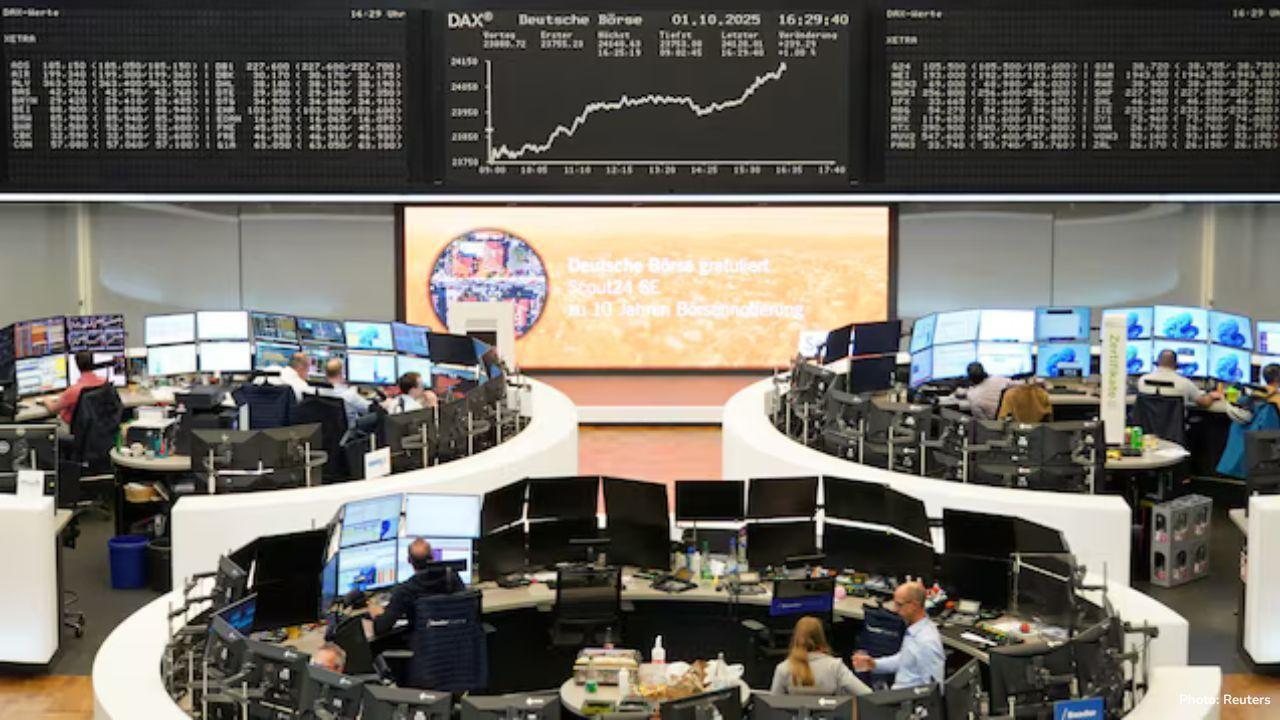
That is why shares in high-growth sectors like technology, especially chip-making companies, rose strongly. The rally spread from Wall Street in the U.S. to markets in Asia, lifting indexes in Japan, Taiwan, Hong Kong, and South Korea. European futures also showed signs of growth.
Impact on Currencies and Gold
Short-term U.S. Treasury yields dropped to their lowest level in two weeks, signaling that investors expect easier money policies ahead. This move also pushed the dollar lower against other major currencies.
Meanwhile, gold continued to shine as a safe investment. Prices recently came close to $3,900 per ounce, a record high, and even after a small pause, it was still trading around $3,866. Many investors turn to gold during uncertain times, and the current economic situation makes it especially attractive.
The Shutdown Problem
While the ADP report gives some information, the government shutdown has blocked the release of official data, including the monthly jobs report that was expected on Friday. This has created a serious challenge for the Federal Reserve.
The Fed relies on data to make decisions about interest rates, inflation, and economic growth. Without updated numbers, it risks “flying blind” when it meets on October 29 to decide whether to cut rates again.
Weekly jobless claims data, which track how many Americans apply for unemployment benefits, will also be delayed because the Labor Department is closed. This means investors will be paying more attention than usual to private data, such as the Challenger layoffs report due later today.
A Divided Washington
The deeper problem is political. The U.S. shutdown happened because of strong divisions between political parties in Washington. These fights not only close government offices but also prevent the smooth flow of important information. Many analysts fear that the battle could drag on, making it harder for the Fed and businesses to plan ahead.
Without official data, the economy’s direction becomes unclear. Workers cannot easily know which industries are hiring, businesses cannot adjust plans with confidence, and the Fed cannot judge how serious the slowdown is.
Voices from the Fed and Europe
Even though government data has stopped, speeches from Federal Reserve leaders will continue. Dallas Fed President Lorie Logan is expected to speak soon, and her comments could give clues about the central bank’s thinking.
Across the Atlantic, European Central Bank (ECB) leaders are also active. Vice President Luis De Guindos, board member Patrick Montagner, Irish central bank chief Gabriel Makhlouf, and Swedish central bank Governor Erik Thedéen are scheduled to address various forums today. Their words may influence European markets, which often react closely to U.S. financial news.
What Lies Ahead
The next few weeks will be important for both the U.S. and the global economy. If the shutdown continues, the world’s largest economy will face growing uncertainty. If job losses continue, people may cut back on spending, which can slow growth even more.
At the same time, falling interest rates and rising stock markets show that investors are still hopeful the Fed will act to prevent a deep recession. But without solid data, even experts cannot be sure of what comes next.
Editorial View
The latest developments highlight two key truths. First, the U.S. job market is in real trouble, and workers are already feeling the effects. Second, political division in Washington is adding unnecessary risk by cutting off the flow of vital economic data.
In difficult times, reliable information is as important as sound policy. Without it, even the smartest decisions become a gamble. For the sake of workers, businesses, and the global economy, Washington must end the shutdown quickly and restore trust in the country’s institutions.


 English