Post by : Meena
Hassan
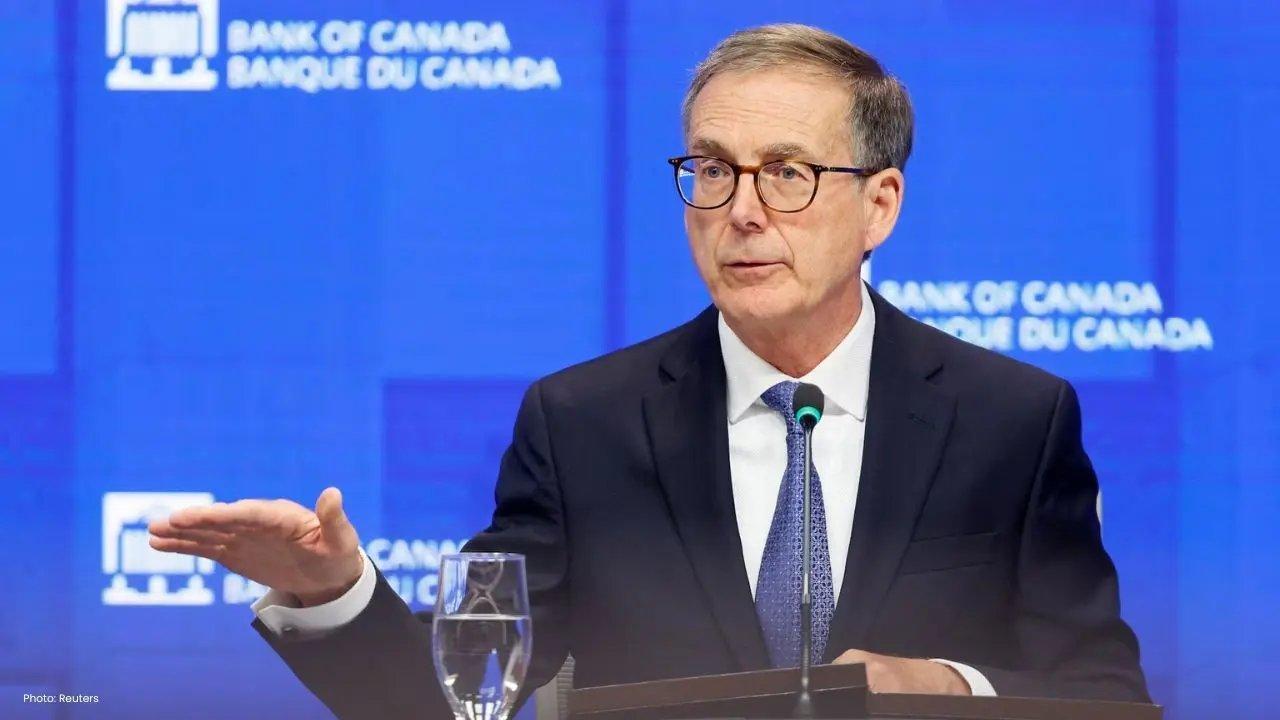
The Bank of Canada is anticipated to maintain its current benchmark interest rate in this week's meeting, marking a pause as the economy exhibits unexpected resilience.
Earlier this year, the central bank cut its policy rate to 2.25 percent in October, suggesting it was the conclusion of a prolonged easing phase. Since then, inflation, output, and employment data have surprised market analysts, illustrating that the economy has adapted well to U.S. tariffs.
Four rate reductions in 2025 brought the total to nine cuts since the middle of 2024. Market sentiment now suggests that rates will likely remain unchanged through most of 2026, with increased expectations for hikes rather than further cuts.
In contrast, the Federal Reserve in the U.S. is projected to reduce its key rate by a quarter point this week, adjusting the federal funds rate to 3.5 percent from 3.75 percent. Economists view this Fed stance as still restrictive, considering the declining labor market conditions in the U.S.
Comments from Fed officials indicate a preference for a rate cut, despite inflation staying above the 2 percent benchmark and challenges posed by data delays due to the government shutdown.
Looking ahead, uncertainty looms regarding the leadership of the U.S. central bank next year. Kevin Hassett, a known ally of President Donald Trump, is perceived as a leading candidate, anticipated to support a reduction in borrowing costs.
In Canada, the situation seems more stable. Bank of Canada Governor Tiff Macklem stated in October that current rates are “at about the right level” to stabilize inflation while adapting the economy. He noted that any additional cuts would necessitate a significant downturn in the economic outlook.
Recent data supports this cautious approach. The annual CPI inflation was reported at 2.2 percent in October, with core metrics hovering near 3 percent. The labor market shows signs of gradual improvement, with 54,000 new jobs added in November and unemployment decreasing to 6.5 percent.
Moreover, economic output showed resilience in the third quarter, avoiding a technical recession. Although much of the 2.6 percent annualized growth was driven by lower imports, it was still better than anticipated. Recent GDP revisions for 2022 to 2024 suggest stronger economic momentum than previously thought.
Analysts mention that this solid trend could clarify why core inflation has remained persistently high and question whether the Bank of Canada would have been as aggressive with cuts had they had this data earlier.
Looking forward to 2026, challenges remain, including negotiations on the USMCA trade agreement. Nevertheless, policymakers assert that monetary policy is not the suitable mechanism to address trade disruptions, underlining that interest rates have limited impact on specific sectors.
The primary focus of the central bank, they argue, is on preventing spillover effects and enabling broader economic adaptation rather than providing direct responses to tariffs or trade uncertainties.


 English