Post by : Meena
Hassan
On Thursday, the Philippines and Japan marked a significant advancement in their defense partnership by finalizing two crucial agreements. One of these agreements facilitates the swift exchange of military supplies and services, enhancing operational collaboration amidst escalating security issues in the region.
The Acquisition and Cross-Servicing Agreement (ACSA) comes after the implementation of a notable Reciprocal Access Agreement between these two U.S. allies. These initiatives are part of a comprehensive strategy to strengthen military ties in light of increasing geopolitical tensions.
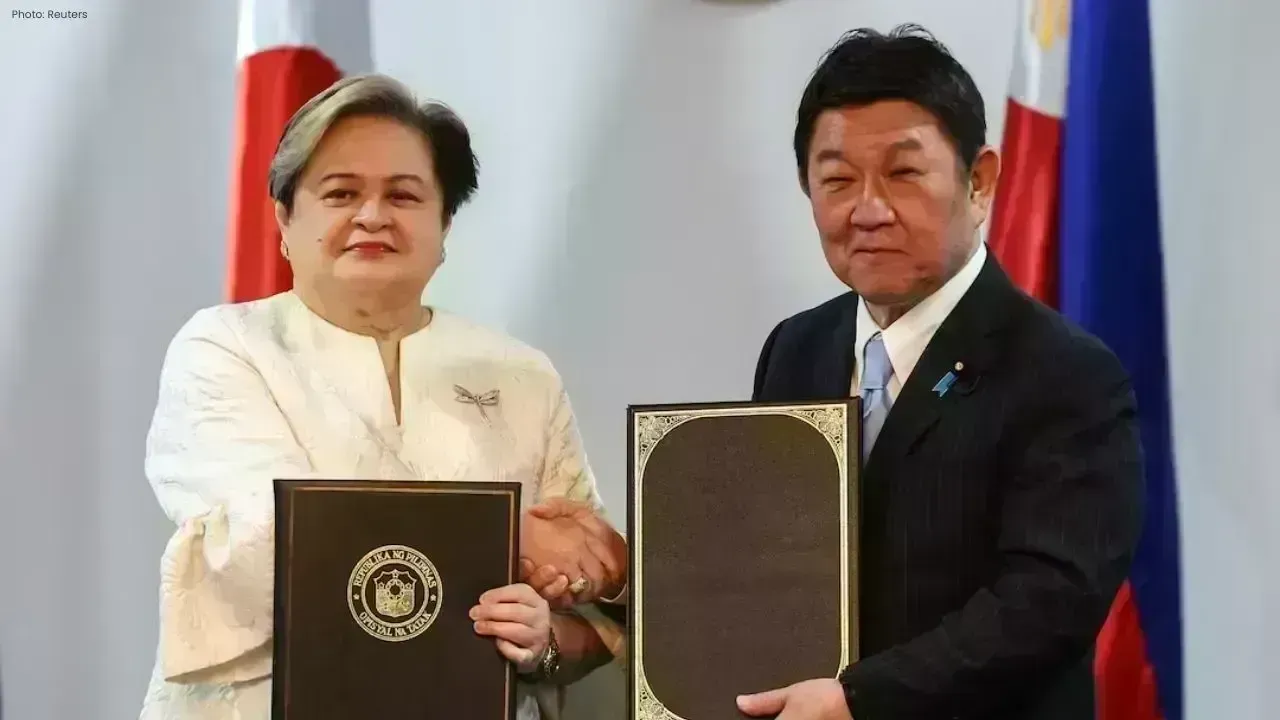
Toshimitsu Motegi, Japan's Foreign Minister, signed the agreements during his recent visit to Manila, which is part of a broader tour of the Middle East and Asia that included Israel, the Palestinian territories, Qatar, and India. This trip underscores Japan’s growing strategic engagement in the region.
During a joint announcement, Motegi and Philippine Defense Secretary Theresa Lazaro revealed a $6 million Official Security Assistance package from Japan. This funding will aid in building facilities for rigid-hulled inflatable boats that Japan has donated, further enhancing the naval capacity of the Philippines.
Japan has voiced consistent concerns about rising maritime conflicts in East Asia, emphasizing its opposition to any unilateral changes to the status quo. Tokyo has recognized Philippine maritime security as vital within a broader trilateral context involving the United States.
“We acknowledged the importance of Japan-Philippines-U.S. cooperation in today's complex strategic landscape,” Motegi noted during a joint press conference with Lazaro.
Japan supports the 2016 ruling by the Permanent Court of Arbitration in The Hague, which dismissed China's extensive claims in the South China Sea—a decision that Beijing disputes. Lazaro reiterated that both countries are committed to upholding the rule of law, including ensuring freedom of navigation and overflight, regarding Japan's role as a crucial strategic partner.
Motegi's visit takes place as the Philippines assumes the chairmanship of the Association of Southeast Asian Nations during a period of increasing tensions in the Taiwan Strait. Japan has stressed that stability around Taiwan is essential for global security. In November, Japanese Prime Minister Sanae Takaichi cautioned that a Chinese assault on Taiwan could provoke a military response from Japan, which sparked a strong reaction from Beijing, including travel bans and export restrictions on select dual-use goods.
China asserts sovereignty over Taiwan, situated just over 100 kilometers from Japanese shores, and has not ruled out the use of force to establish control. Taiwan has firmly rejected these claims, stating that its future can only be determined by its own people.
In light of these dynamics, Japan is embarking on a historic military buildup aimed at counteracting China’s increasing assertiveness while reinforcing its alliances across East Asia.


 English