Post by : Saif
Al-Najjar
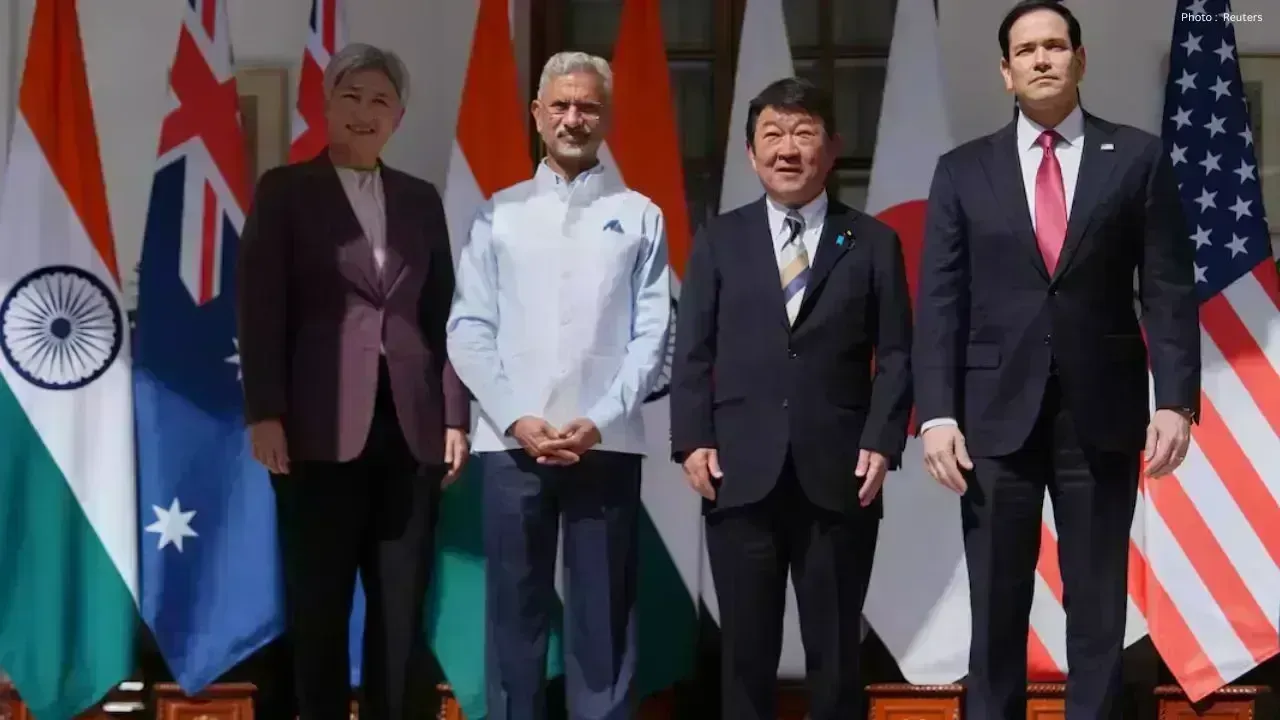
In a significant gathering, foreign ministers from India, the United States, Japan, and Australia came together in New Delhi to address key issues of regional security, economic collaboration, and the shifting power dynamics in the Indo-Pacific.
This meeting has revitalized focus on the Quad alliance amid ongoing geopolitical rivalries, maritime security challenges, and economic obstacles that are altering the landscape of international relations across Asia and the Pacific.
The Quadrilateral Security Dialogue, known as the Quad, unites four democratic nations dedicated to addressing regional stability, trade relations, technology, infrastructure, and defense collaboration.
Despite not being a formal military alliance, it has emerged as a crucial strategic platform amid escalating tensions in the Indo-Pacific.
During their discussions in New Delhi, ministers explored cooperative initiatives in areas including maritime security, supply chain resilience, disaster response, technological partnerships, and economic development.
The gathering also underscored heightened concerns among member countries about China’s growing influence in the Indo-Pacific. Officials steered clear of explicit confrontational remarks, yet security matters were pivotal in the dialogue.
China has consistently criticized the Quad, describing it as a Cold War-era strategy aimed at curbing its influence in Asia. Nevertheless, the Quad nations assert their cooperation is geared towards ensuring a free, open, and prosperous Indo-Pacific.
India’s significance in this assembly has risen owing to its strategic location, economic advancements, and diplomatic clout within Asia. Hosting this meeting highlighted India’s escalating role in both regional and global diplomatic arenas.
The United States continues to prioritize the Indo-Pacific in its foreign policy, fostering partnerships in the region as competition with China intensifies across trade, technology, military stature, and strategic alliances.
Japan and Australia maintain active involvement in planning for regional security related to maritime tensions, vulnerabilities in supply chains, and geopolitical unpredictability.
Analysts argue that the Quad aims to fortify its importance by broadening its focus beyond military and security spheres. Increasingly, the group is investing in infrastructure projects, emerging tech, climate initiatives, healthcare partnerships, and economic resilience.
This expansive approach may enhance regional collaborations, portraying the alliance as a vehicle for long-term development rather than merely as a military counterbalance.
The meeting in New Delhi is set against a backdrop of significant geopolitical transformations globally. Conflicts in Europe, instability in the Middle East, trade disputes, and evolving alliances have heightened the urgency for countries to reinforce diplomatic and strategic ties.
For India, juggling relationships with both Western powers and regional actors remains a critical diplomatic pursuit. New Delhi is actively seeking strategic autonomy while augmenting collaboration with various global partners.
The Quad epitomizes the evolving security priorities within Asia. Maritime routes in the Indo-Pacific are crucial for global commerce, energy transportation, and economic viability. Disruptions in these waters threaten international markets and supply chains.
As a result, nations in the region are increasingly putting emphasis on naval cooperation, infrastructure investments, and technological partnerships to bolster long-term stability.
Experts believe that the Quad's future viability hinges on the ability of member countries to stay unified despite divergent economic interests and diplomatic nuances.
Each member has its own relationship with China, complicating strategic coordination. Yet, the shared apprehension over regional security continues to draw the nations closer together.
This meeting also conveys a vital diplomatic message regarding the growing significance of multilateral partnerships in contemporary international relations. Countries are leaning more on regional collaborative efforts to tackle security, economic, and technological issues.
Smaller nations in the Indo-Pacific are closely monitoring the Quad’s moves, as these partnerships can significantly affect trade prospects, infrastructure projects, and geopolitical stability.
At the same time, experts warn that escalating tensions between major global players could further exacerbate problems if diplomatic dialogues erode.
This New Delhi meeting, therefore, marks both an initiative to enhance regional collaboration and a mirror of the wider geopolitical contests shaping today’s world.
As the Indo-Pacific increasingly becomes a focal point of strategic importance, the role of the Quad is sure to attract significant international scrutiny in the years to come.


 English