Post by : Bianca
Haleem
A SpaceX rocket stage that launched two lunar landers has crashed into the moon after spending more than a year drifting through space. Scientists said the impact happened as predicted on Wednesday when the unused upper stage struck the lunar surface at about 5,400 mph (8,700 kph).
Although no one directly witnessed the collision, researchers later detected evidence that strongly indicates the crash took place. A telescope in Chile observed what astronomers identified as a debris plume created by the impact. Space tracking experts also said the rocket's collision with the moon was unavoidable.
Telescope Detects Evidence of Lunar Impact
According to Boston University's Carl Schmidt, his team is "100% certain" that the observations confirmed signs of the lunar collision. The European Southern Observatory's Very Large Telescope detected a stream of sodium and lithium extending for tens of kilometers into space for five to 10 minutes after the impact.
Read More: Ajman Real Estate Deals Reach AED1.65 Billion in July
Schmidt explained that while there are no direct images of the collision itself, the telescope data provides strong evidence that the impact occurred.
Experts Say Crash Was Expected
Retired astrophysicist Jonathan McDowell said observations made on Tuesday night showed the abandoned 4-ton upper stage travelling directly toward the moon. The predicted impact location was near Einstein Crater, a dusty region on the moon's sunlit western edge close to the boundary between the near and far sides, making it difficult to observe from Earth.
McDowell said he has "no doubt" that the rocket broke into small pieces after hitting the lunar surface near Einstein Crater. He added that, as a physicist, it was expected that the object would eventually come down after being left in space.
Scientists Await NASA Confirmation
Astronomers knew it would be extremely difficult to observe the dust cloud or flash produced by the impact from Earth. Spacecraft orbiting the moon had the best chance of recording the event or later photographing the newly formed crater.
Dutch scientist Marco Langbroek also attempted to observe the impact with his telescope but did not detect it. Despite this, he said he had no doubt that the rocket struck the moon as predicted.
McDowell noted that visual confirmation is expected only after NASA's Lunar Reconnaissance Orbiter passes over the impact site and captures images of the crater. NASA expects those photographs to become available next week.
Rocket Was Part of 2025 Lunar Mission
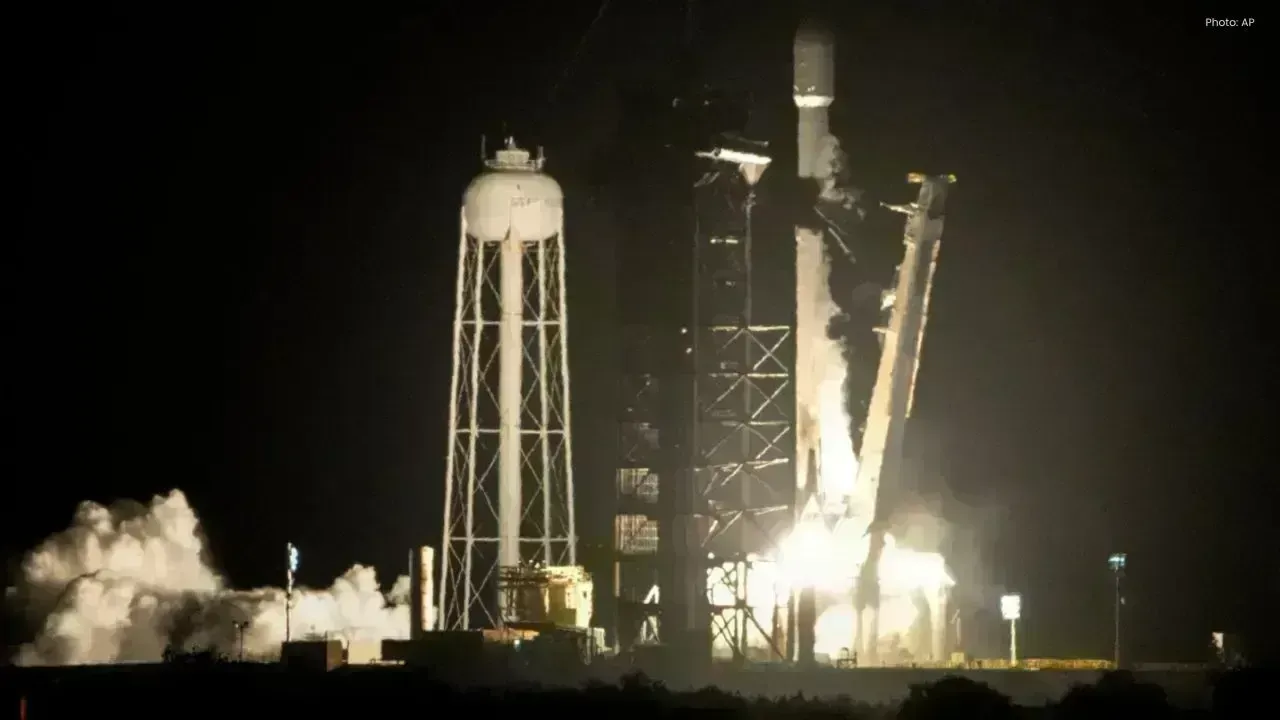
The crashed object was the Falcon rocket's upper stage, a cylinder measuring more than 40 feet (12 meters) long. It launched from Cape Canaveral on January 15, 2025, carrying two private lunar landers into space.
The rocket successfully placed Firefly Aerospace's Blue Ghost and ispace's Resilience on their paths to the moon before remaining adrift in space. Blue Ghost later became the first private spacecraft to successfully land on the moon, while Resilience crashed during its mission.
SpaceX Says Impact Was Unintentional
SpaceX's Julianna Scheiman said the company has been working with NASA to prevent similar incidents in the future. She emphasized that the collision was not planned.
According to Scheiman, a combination of solar activity and gravitational forces gradually altered the rocket's path, eventually sending it onto a collision course with the moon.
Growing Concern Over Lunar Space Debris
The latest impact has renewed attention on the growing issue of debris around the moon as space missions continue to increase. Scientists noted that a Chinese rocket also unintentionally struck the moon in 2022 after completing a lunar mission, while several other discarded rocket stages may have impacted the lunar surface in earlier decades without being detected.
NASA is preparing for more robotic missions aimed at supporting a long-term human presence on the moon. Elon Musk's SpaceX and Jeff Bezos' Blue Origin are developing lunar landers for NASA's Artemis program.
SpaceX's Starship continues test flights from Texas, while Blue Origin's Blue Moon lander has not yet launched. One or both vehicles are expected to support Artemis III next year during a docking rehearsal in Earth orbit, with a crewed lunar landing potentially taking place as early as 2028.
McDowell said activity around the moon will continue to increase, adding that future impacts creating large clouds of lunar dust would become less acceptable as more spacecraft begin operating in the region.


 English