Post by : Bianca
Haleem
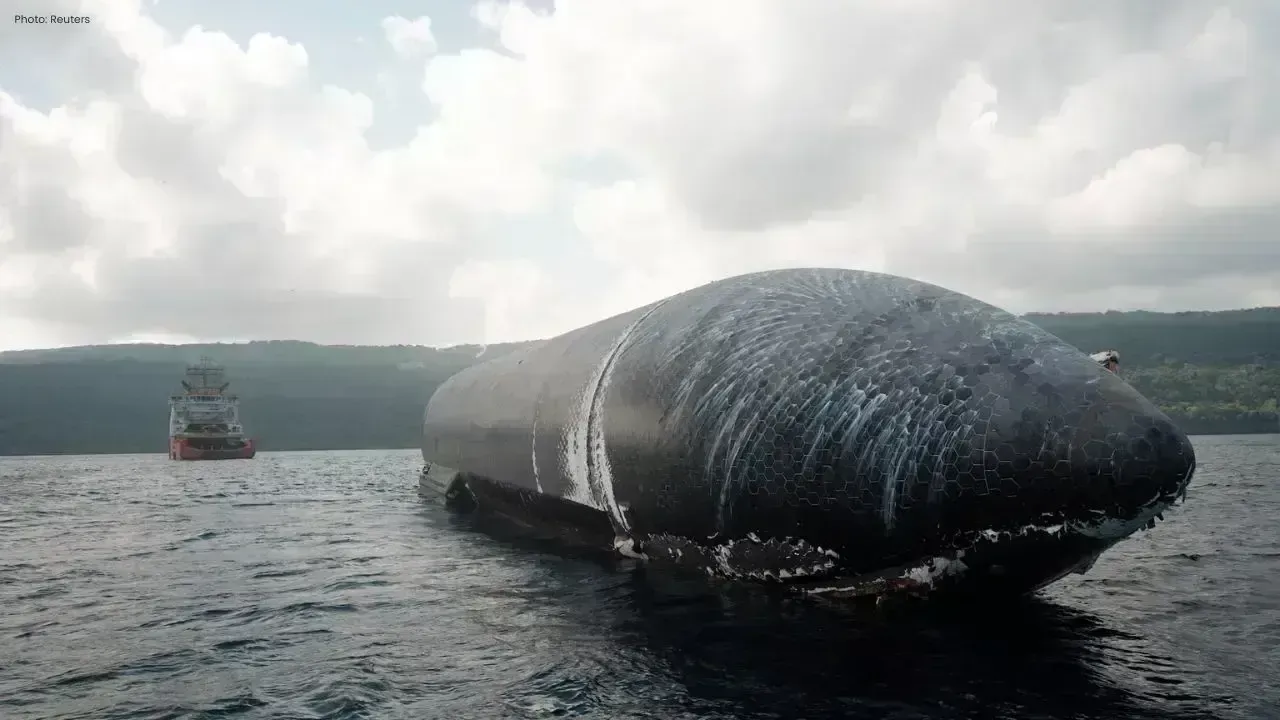
SpaceX’s Starship Ship 40 has successfully reached calmer waters off the coast of Christmas Island after spending 24 days at sea following its latest test flight. The spacecraft’s arrival marks an important moment for SpaceX because Ship 40 became the first Starship upper stage to survive an ocean splashdown intact.
Ship 40 was launched on July 24 from SpaceX’s Starbase facility in South Texas as part of Starship Flight 13. The spacecraft completed its planned mission and performed a controlled splashdown in the Indian Ocean.
Unlike previous Starship test flights, the spacecraft did not break apart after reaching the water. This unexpected survival gave SpaceX an opportunity to attempt something the company has not been able to do with an earlier Starship upper stage: recover the vehicle after it had returned from space.
24-Day Recovery Operation
Recovering Ship 40 from the Indian Ocean has been a difficult operation for SpaceX’s recovery teams. The spacecraft remained at sea for more than three weeks while teams worked to tow the huge vehicle toward safer and calmer waters.
SpaceX said the recovery effort faced challenging conditions, including increasingly rough seas. At one stage, the company’s effort to bring the spacecraft safely back to shore appeared uncertain.
Despite those difficulties, the recovery team managed to continue the operation and eventually moved Ship 40 toward Christmas Island, an Australian territory located in the Indian Ocean.
The approximately 171-foot (52-meter) Starship upper stage is now floating offshore in calmer water. SpaceX engineers are traveling to the area to examine the vehicle before the company attempts the next stage of its recovery operation.
Read Also: Saudi, Qatar Leaders Discuss Regional Security and Cooperation
Why Ship 40 Is Important for SpaceX
Ship 40 is particularly valuable because it gives SpaceX engineers an opportunity to study a Starship vehicle that has completed a spaceflight and returned to Earth in one piece.
Previous Starship test vehicles have generally been expected to break apart or be destroyed after completing their missions. Ship 40’s survival therefore provides engineers with physical hardware that can be examined in detail.
Engineers can potentially study several important parts of the spacecraft, including its aerodynamic surfaces, hydraulic systems, thermal protection tiles, engines and overall structural condition.
The information collected from Ship 40 could help SpaceX identify what worked during the flight and what areas still require improvement before Starship moves toward more routine and fully reusable operations.
Starship’s Version 3 Design
Flight 13 was the second launch involving SpaceX’s Version 3 Starship design.
The first V3 flight, Flight 12, did not complete its planned mission as expected. Engine-related problems after stage separation affected the Super Heavy booster, which ultimately crashed into the Gulf of Mexico rather than completing a controlled splashdown.
During Flight 13, the upper stage performed a controlled landing burn over the Indian Ocean. Ship 40 then entered the water and, unlike Ship 39 from the earlier flight, remained intact.
That difference has made Ship 40 an important test article for SpaceX’s engineers.
Christmas Island Becomes the Recovery Location
Christmas Island is an Australian territory located in the Indian Ocean, roughly 1,200 miles (1,900 kilometers) northwest of Broome, Australia.
The island is best known for its extensive national park and its famous red crab migration, when millions of crabs move toward the coast to reproduce.
For SpaceX, however, the waters around Christmas Island have temporarily become an important recovery area for one of the company’s largest spacecraft.
The calmer conditions provide engineers with a better environment to inspect Ship 40 and assess its condition before attempting to move it farther.
What SpaceX Can Learn From Ship 40
The successful splashdown gives SpaceX a rare opportunity to examine how Starship performs after experiencing the extreme conditions associated with launch, spaceflight, atmospheric re-entry and landing.
The company’s development strategy relies heavily on testing hardware, identifying problems and applying lessons to future vehicles.
A detailed inspection of Ship 40 could help engineers understand how the spacecraft’s heat-shield tiles, aerodynamic systems, hydraulic components and structural elements performed during the mission.
These findings could influence the design and preparation of future Starship vehicles.
SpaceX Preparing for Starship Flight 14
While Ship 40 is being examined, SpaceX is already preparing for its next major Starship test.
The company is working on Ship 41 and its Super Heavy booster for Flight 14. One of the major objectives for the upcoming mission is to move closer to full Starship reusability.
SpaceX plans to attempt an even more ambitious recovery operation by bringing the Starship upper stage back toward the Starbase launch site and attempting to catch it using the giant mechanical arms of the launch tower, commonly known as “Mechazilla.”
A successful catch would represent a major step toward SpaceX’s goal of rapidly reusing Starship hardware.
Starship’s Role in NASA’s Moon Missions
Starship’s development is also closely connected to NASA’s Artemis program.
NASA has selected a Starship-derived vehicle to support future crewed lunar missions. SpaceX is developing a lunar version of Starship that is intended to transport astronauts to the Moon as part of NASA’s Artemis plans.
Before Starship can regularly carry astronauts, SpaceX still needs to demonstrate several critical capabilities, including reliable orbital operations, safe atmospheric re-entry, controlled landing and repeatable recovery.
The data collected from successful test flights such as Flight 13 could therefore become important as SpaceX works toward those future missions.
A Major Step Toward Full Reusability
SpaceX’s long-term objective is to make Starship a fully reusable launch system capable of carrying people and cargo to Earth orbit, the Moon and eventually other destinations.
The survival of Ship 40 after its splashdown is significant because it provides engineers with a vehicle that can be examined rather than simply recovered as debris.
The spacecraft’s journey from the Indian Ocean to calmer waters near Christmas Island has been challenging, but the recovery effort could ultimately provide valuable engineering data.
For SpaceX, Ship 40 is more than a surviving test vehicle. It is an opportunity to learn from a spacecraft that has experienced an entire test-flight cycle and returned to Earth intact.
The next major milestone will be determining the condition of Ship 40 and whether SpaceX can safely transport it back to Starbase for further analysis. Meanwhile, preparations for Flight 14 are already underway, keeping the company’s rapid Starship testing program moving forward.


 English