Post by : Bianca
Haleem
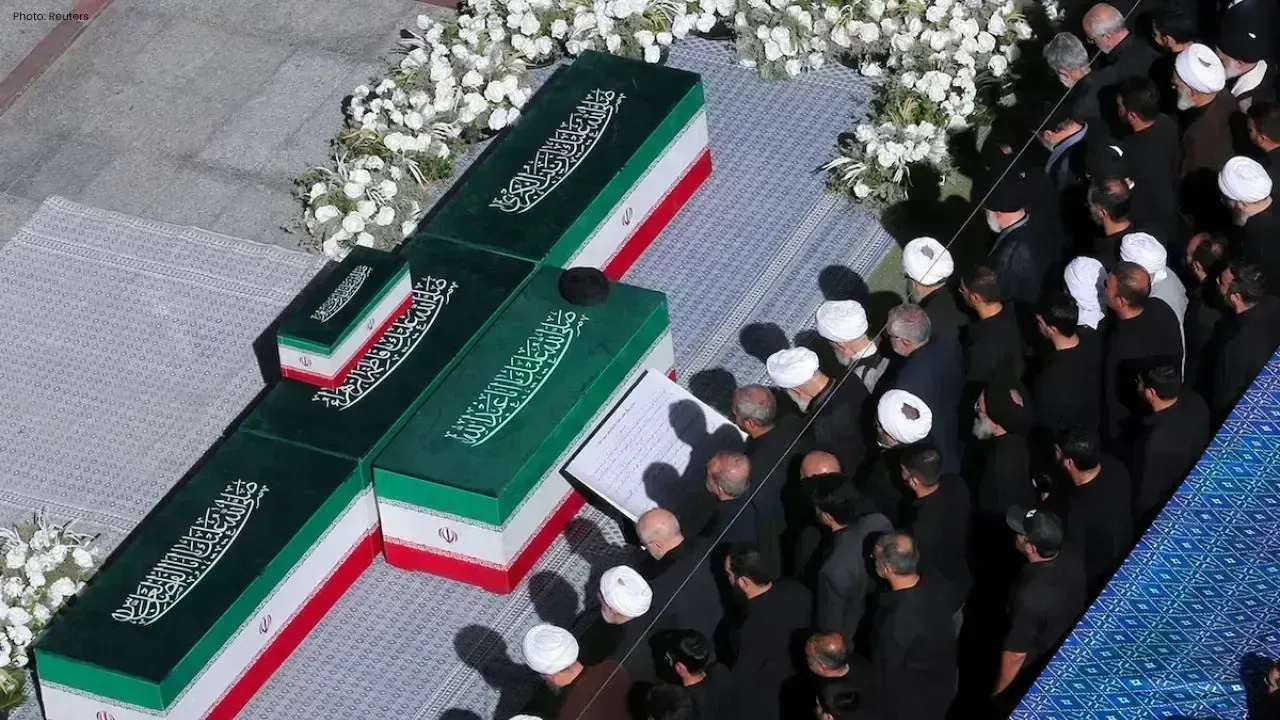
Iran on Friday buried its former Supreme Leader Ali Khamenei, more than four months after he was killed in an airstrike on February 28. His funeral concluded with his burial at the memorial hall inside the Imam Reza Shrine in Mashhad, his hometown in eastern Iran.
Khamenei's coffin, covered with the Iranian flag, was carried into the shrine while large crowds gathered outside to attend prayers. Iran's state broadcaster IRIB confirmed that the "body of the martyred leader of the Islamic Revolution was buried in the memorial hall of the shrine of Imam Reza."
There was no public appearance by his son and successor, Mojtaba Khamenei, during the ceremony.
Senior Iranian Leaders Attend Final Ceremony
Several of Iran's top officials attended the burial, including Parliament Speaker and chief nuclear negotiator Mohammad Bagher Ghalibaf, Chief Justice Gholamhossein Mohseni Ejei, and Khamenei's eldest son, Mostafa Khamenei.
State television showed senior officials standing beside the coffin, with some seen in tears during the ceremony.
Read More: US Launches Strikes on Over 80 Iranian Targets After Ship Attacks
Although Mojtaba Khamenei was appointed as Khamenei's successor, he did not appear at any stage of the funeral. Since his appointment, he has communicated only through written statements and is reported to have been wounded during the February 28 airstrikes.
Burial Takes Place During Renewed US-Iran Military Exchanges
The burial came as Iran and the United States exchanged attacks for a second consecutive day, raising fears of a broader conflict in the region.
Iranian officials said US strikes killed 17 people, while state media reported that one attack hit a railway line between Tehran and Mashhad.
Iran also announced that it had resumed attacks on US assets in Kuwait, Bahrain, and Qatar. Meanwhile, Jordan's military said it intercepted eight missiles launched from Iran after air raid sirens sounded across the country.
However, a US defence official stated that the missiles and drones launched by Iran were either intercepted or caused no significant damage, adding that no American personnel were injured.
Crowds Call for Revenge During Funeral
Thousands of mourners dressed in black gathered in Mashhad for the final funeral ceremony.
Many in the crowd called for revenge against US President Donald Trump. AFP correspondents reported that one slogan displayed in English read, "Hey Trump we will kill you."
At the same time, The Wall Street Journal reported, citing anonymous sources, that Israel had informed the United States about intelligence suggesting a new Iranian plot targeting Trump.
Reports of Fresh Military Strikes
Iranian state media reported that the United States struck the perimeter of Iran's only civilian nuclear power plant in Bushehr. The report cited the deputy governor of Bushehr province.
State media also said another projectile struck a military headquarters on the outskirts of Bushehr. However, a US defence official said the US military was not conducting strikes inside Iran at that time.
Another reported strike hit a section of the Tehran-Mashhad railway around 55 kilometres from Mashhad, forcing authorities to suspend train services and transfer passengers to buses.
Iran Says It Targeted US Military Systems
Iran's army said it used drones to target a Patriot missile system in Kuwait, an early warning system in Qatar, and fuel tanks in Bahrain as part of operations against US military bases in the Gulf.
US officials maintained that the attacks caused no major damage and resulted in no casualties among American personnel.
Security around Khamenei's burial remained high. Footage released on the supreme leader's official website showed at least one fighter jet escorting the aircraft carrying his coffin to Mashhad.
Israel Warns of Possible Future Action
Following Israel's war with Iran in June 2025 and the current conflict, Israeli Defence Minister Israel Katz said his country was prepared to strike Iran again if necessary.
He warned that Israel could attack Iran for a "third time" and said any future operation would be carried out "with even greater force."
Israeli Prime Minister Benjamin Netanyahu also said Israel was preparing for every possible scenario. His office confirmed that he spoke with US President Donald Trump on Thursday and received an update on American military actions in the Gulf.
Strait of Hormuz Remains a Major Flashpoint
The Strait of Hormuz continues to be a key area of tension between Iran and the United States.
Iran has insisted on maintaining control over the strategic waterway, even though it had remained open for international shipping before the conflict.
Iranian forces reportedly struck at least three ships in recent days, leading to extensive US military strikes beginning on Tuesday.
According to maritime tracking company Kpler, shipping traffic through the Strait of Hormuz has dropped sharply since Wednesday, particularly along the UN-backed Omani route, following attacks on vessels earlier this week.


 English