Post by : Saif
Al-Najjar
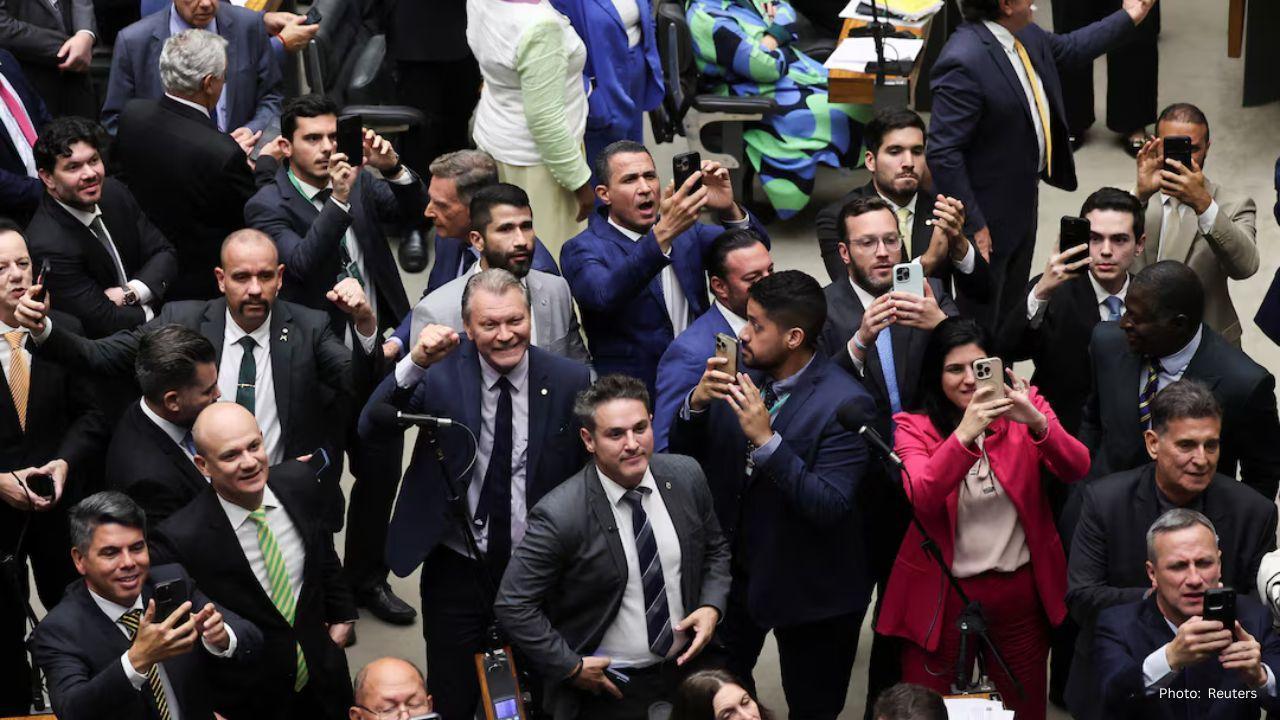
The lower house of Brazil's Congress has taken a pivotal step by approving legislation that could dramatically slash former President Jair Bolsonaro’s prison sentence. This decision was made early Wednesday and has already ignited a fervent debate within Brazil and on the global stage.
As reported by France 24 and AFP, the proposed law has the potential to reduce Bolsonaro’s current 27-year sentence to just over two years, contingent upon the Senate’s approval. The Brazilian government has yet to issue a response to inquiries regarding this measure, and Reuters has not independently verified the details.
Bolsonaro's legal issues arose after his conviction for attempting to overturn the outcomes of the 2022 election, where he was defeated by President Luiz Inacio Lula da Silva. Investigations revealed his involvement in inciting supporters to contest the democratic process, which led to the riots in Brasília on January 8, 2023, targeting crucial government buildings—a situation that has drawn widespread condemnation.
The former president commenced his sentence last month at the Federal Police Superintendency in Brasília. Despite his incarceration, he continues to enjoy substantial backing from many political allies and loyal followers, visible during the recent vote in the lower house as supporters celebrated the bill's approval.
In a bid to amend his imprisonment conditions, Bolsonaro’s legal team filed a request on Tuesday to transfer him from prison to a hospital for “surgical procedures.” They have also reiterated a plea for him to serve the remainder of his term under “humanitarian house arrest,” highlighting growing concerns regarding his health and prison conditions.
Conversely, the proposed legislation has sparked further division in Brazil’s already polarized political landscape. Supporters contend that the bill is essential for ensuring equitable treatment for all individuals charged stemming from the January 8 riots, arguing that many penalties were overly harsh and require recalibration.
Detractors, however, argue that the bill primarily benefits Bolsonaro, shielding influential figures from facing the repercussions of their actions. They caution that reducing Bolsonaro's sentence might undermine Brazil’s efforts to uphold democratic principles, conveying a perilous message that political leaders can evade accountability.
The legislature will now send the bill to the Senate, where rigorous debate is anticipated. Senators will face a critical decision: to uphold the lower house's decision or to maintain Bolsonaro’s existing sentence.
This development is crucial for Brazil, encapsulating broader issues surrounding justice, democracy, and the rule of law. The outcome will likely influence public perceptions of governmental institutions well into the future.
As Brazil awaits the Senate’s verdict, all eyes are on the nation, which stands at a crucial juncture between political allegiance, democratic values, and the necessity for a fair justice system.


 English