Post by : Shakul
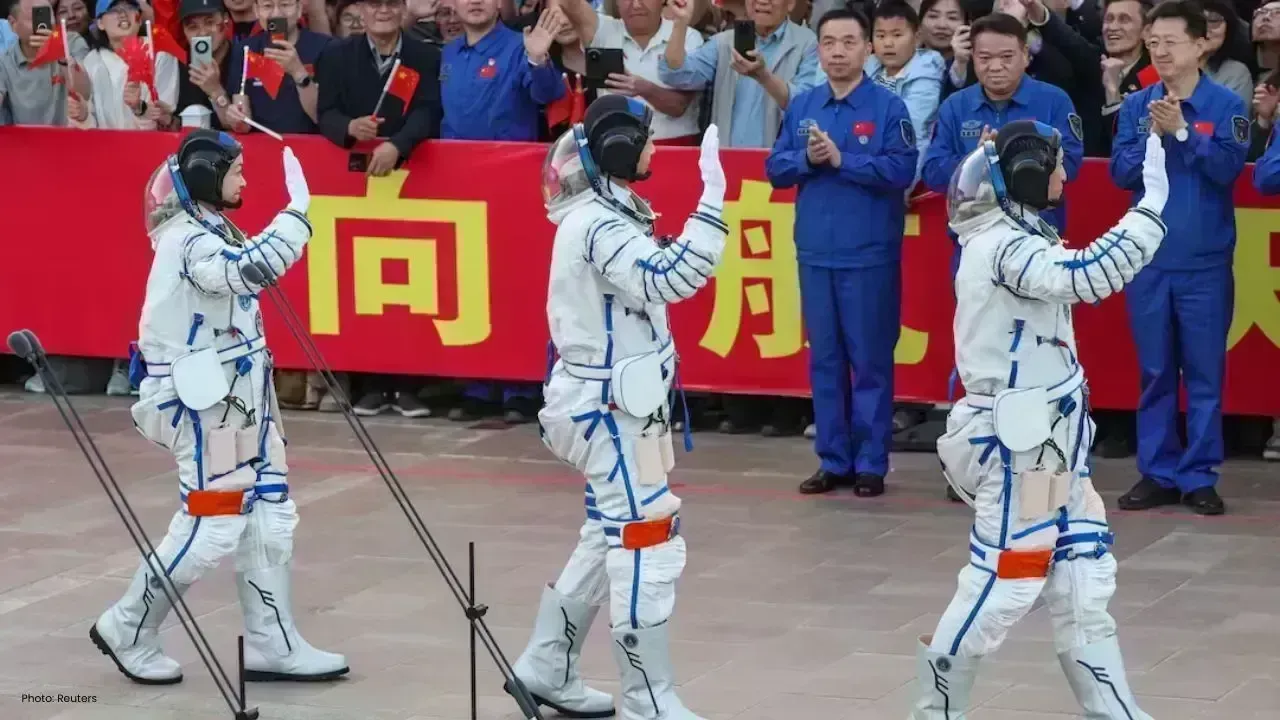
China has successfully launched the Shenzhou-23 mission from the Jiuquan Satellite Launch Center, signaling a significant advancement in its goal to land astronauts on the moon by 2030. This spacecraft is carrying three astronauts to the Tiangong space station, with one astronaut set to remain in orbit for an unprecedented year, marking China’s longest human space mission to date.
The Shenzhou-23 took off aboard a Long March-2F Y23 rocket late on Sunday. The team includes commander Zhu Yangzhu, pilot Zhang Yuanzhi, and payload specialist Li Jiaying, who made history as the first astronaut from Hong Kong to join a Chinese mission. Officials in China heralded this launch as an essential benchmark in their expanding space capabilities.
As mentioned by the China Manned Space Agency, the extended mission will enable researchers to examine the long-term impacts of space travel on human health. They aim to track radiation exposure, changes in bone density, mental stress, and various other physiological responses astronauts face during prolonged missions. This research is significant for preparing future lunar explorations.
China's space initiative has seen rapid development in the past decade, intensifying competition with the United States in the realm of space exploration. The nation aims to carry out a crewed lunar landing before 2030 and collaborate with Russia to establish a permanent lunar research base by 2035. Officials emphasize that the Shenzhou-23 mission will also assess advanced autonomous docking systems, crucial for future moon expeditions.
The mission takes place amidst heightened global competition in space exploration. NASA is planning a moon landing for 2028 under the Artemis program, while SpaceX is actively testing its next-generation Starship rockets for deep-space missions. Chinese scientists assert that their developing space infrastructure, bolstered by successful Tiangong operations, positions China as a key player in global space activities.
In recent years, China has marked several historic achievements, including being the first to retrieve samples from the far side of the moon in 2024. The country has also conducted multiple extensive crewed missions to Tiangong since 2021, progressively refining life-support systems, orbital technology, and astronaut training.
One of the most anticipated goals of the Shenzhou-23 mission is advancing research on human survival in space. Reports from Chinese state media indicate that scientists are examining human stem cells and artificial embryo studies aboard the space station to gain insights into how humans could potentially sustain life and reproduce in long-term space settings.
Experts believe that the success of the Shenzhou-23 mission could significantly boost China’s confidence in its upcoming lunar projects. As the global lunar exploration race intensifies, Beijing is increasingly positioning itself as a leader in space technology, scientific research, and deep-space exploration.


 English