Post by : Raina
Al-Fahim
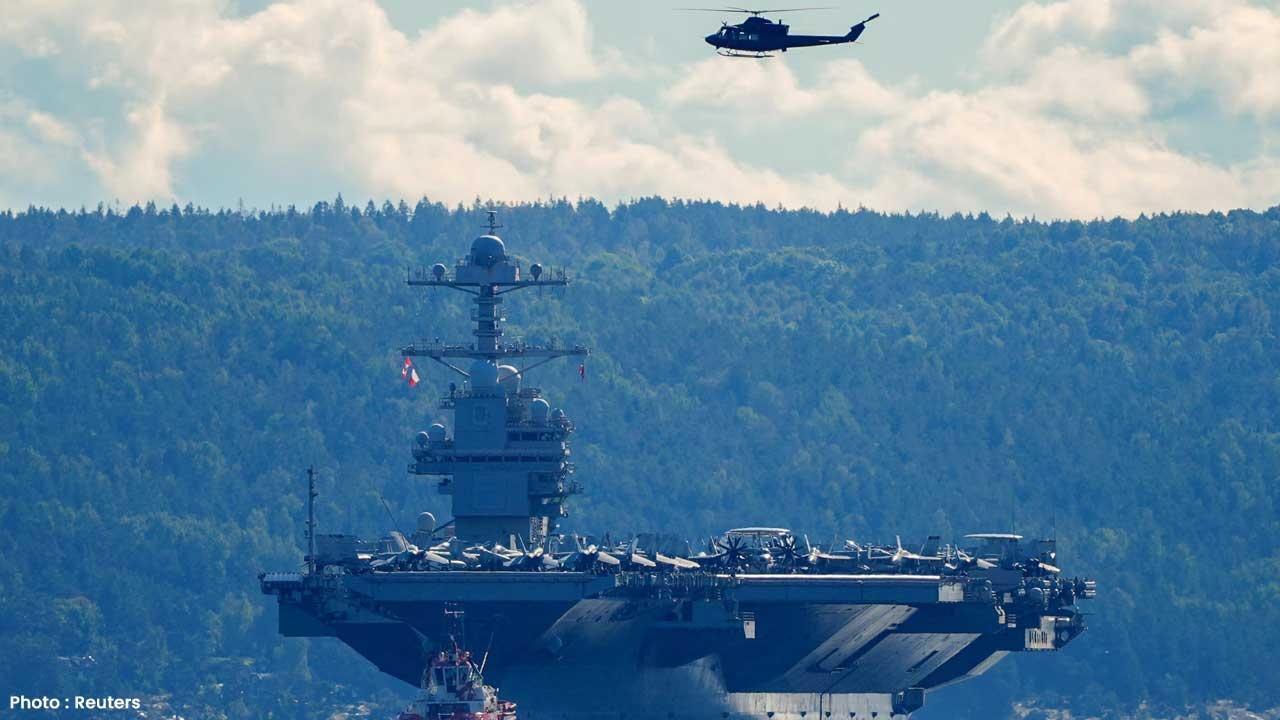
The deployment of the USS Gerald R. Ford, the newest aircraft carrier in the US Navy, marks a significant escalation in American military activity in the Caribbean, which is now at its highest level in decades. This operation, announced by the Navy on Sunday, has ignited debates over the United States' intentions, especially as it continues to launch targeted strikes against vessels accused of drug-related activities.
The arrival of the Ford coincides with Operation Southern Spear, which the Trump administration purports is dedicated to combating narcotics. However, the scale of the deployment—with nearly twelve warships and around 12,000 military personnel—has led many to speculate that this mission also serves as a strategy to apply pressure on Venezuelan President Nicolás Maduro.
As the aircraft carrier passed through the Anegada Passage, US officials characterized the deployment as essential for the protection of the Western Hemisphere. Rear Adm. Paul Lanzilotta remarked that the increased presence enhances America’s capacity to defend against narco-terrorism, while Adm. Alvin Holsey emphasized the critical nature of this move in dealing with the growing threats in the region.
This strategic move comes amid a spike in US military strikes, including the recent destruction of a boat in the Pacific that the United States claims was involved in drug trafficking. Although the military has documented these attacks, they have not provided substantial evidence regarding the targeted individuals, leading to widespread criticism from human rights advocates and local leaders demanding accountability.
The responses in the Caribbean community showcase a stark divide. Officials in Trinidad and Tobago, located just miles from Venezuela, announced joint military training exercises with American forces aimed at curbing drug trafficking and violence. These training sessions, which include Marines from the 22nd Expeditionary Unit, have been taking place near the Venezuelan coastline.
Conversely, reactions from Venezuela have been notably hostile. The Venezuelan government has consistently condemned the presence of US military forces, labeling these exercises as aggressive acts that threaten its sovereignty. While there has been no formal response from Maduro regarding the Ford's arrival, he declared on social media that Venezuela is prepared to defend itself against foreign aggression.
Political pressure on Maduro is escalating further. Secretary of State Marco Rubio announced the formal designation of the Cartel de los Soles as a foreign terrorist organization, claiming it is managed by Maduro and his senior officials as part of a significant narcotics trafficking network. This designation will impose stricter penalties for any material support provided to the cartel, potentially isolating the Venezuelan government even more.
Critics raise concerns over the aircraft carrier deployment, suggesting it signifies a potentially broader military strategy rather than just a focus on drug interdiction. While some think the Ford may serve as an intimidation tactic against Maduro, there are fears that this raises the likelihood of a more extensive military campaign within Venezuela itself. President Trump has signaled a willingness to extend US operations beyond maritime activities, aiming to halt drug trafficking through additional means.
As tensions rise, Latin American nations, human rights organizations, and global observers remain vigilant about the changing dynamics in the region. Senior analyst Elizabeth Dickinson from the International Crisis Group stated that the current situation serves as a crucial test of America’s resolve to assert its military power in Latin America, noting the significant anxieties this deployment has instigated both in Venezuela and neighboring nations.
With the USS Gerald R. Ford now positioned and aggressive US operations ongoing, the Caribbean has transformed into a pivotal arena for geopolitical confrontation. The lingering question is how far the United States is willing to escalate its military involvement and how Venezuela will react as hostilities increase.


 English