Post by : Bianca
Haleem
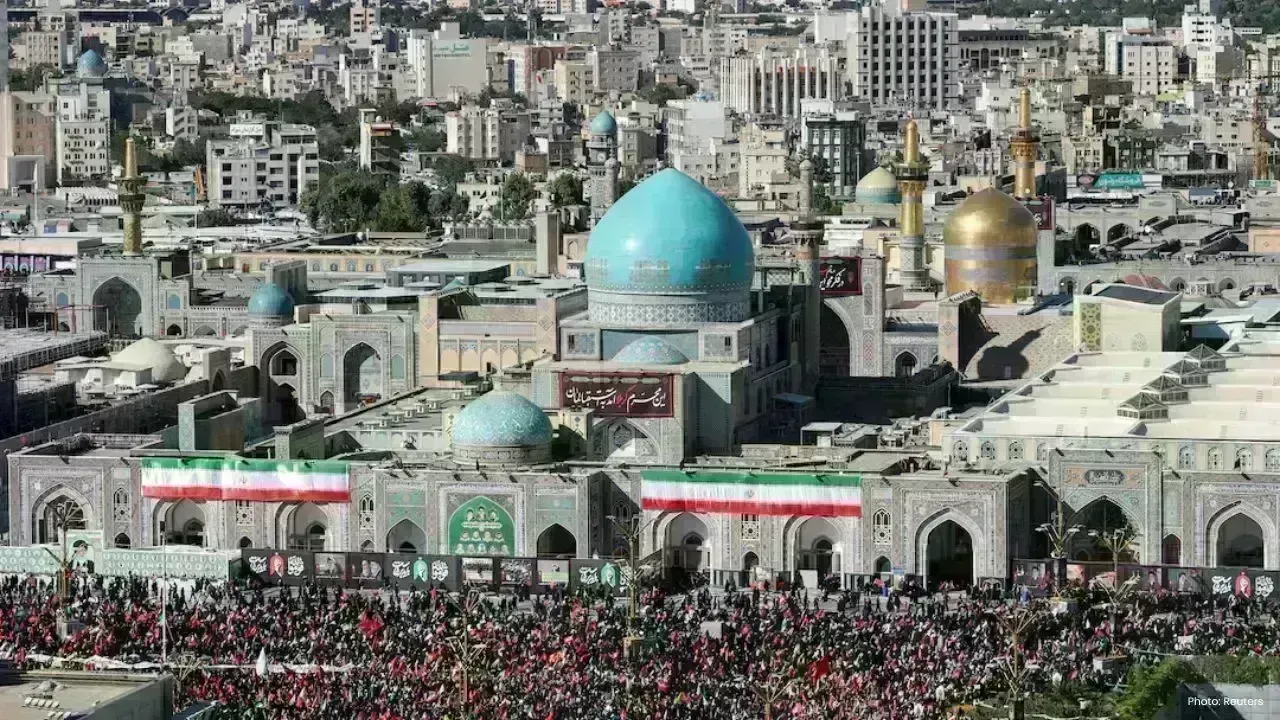
Huge crowds gathered in the holy city of Mashhad as Iran's late Supreme Leader, Ayatollah Ali Khamenei, was laid to rest at the Imam Reza Shrine, the country's holiest Shia Muslim site. The burial marked the end of six days of public mourning ceremonies held across five cities in Iran and neighbouring Iraq.
According to Iran's state news agency IRNA, the burial took place as renewed military exchanges between Iran and the United States raised concerns over the future of a preliminary agreement aimed at ending the conflict in which Khamenei was killed.
Revolutionary Guards Accuse US of Railway Bridge Attack
Earlier in the day, Iran's Revolutionary Guards claimed that the United States carried out overnight strikes on two railway bridges connecting Tehran and Mashhad. The Guards alleged the attacks were intended to overshadow the funeral ceremonies.
The accusation came during a period of renewed hostilities between the two countries following recent military exchanges.
Khamenei Killed in Israeli Strike on February 28
Ayatollah Ali Khamenei and several members of his family were killed in an Israeli strike on their residence in Tehran on February 28, the first day of Iran's war with the United States and Israel.
Following his death, Khamenei was succeeded as Supreme Leader by his son, Mojtaba Khamenei. However, Mojtaba has not appeared in public since reports that he was seriously wounded in the same attack. The 56-year-old did not attend the funeral ceremonies in Tehran or Qom, and there was no indication that he was present at the burial in Mashhad.
Coffins Arrive in Mashhad After Iraq Processions
On Thursday morning, a plane carrying the coffins of Ali Khamenei, his granddaughter, son-in-law, daughter and Mojtaba Khamenei's wife arrived in Mashhad from Iraq.
Before reaching Iran, large funeral processions were held in the Iraqi cities of Najaf and Karbala, where thousands of mourners gathered at two important Shia shrines.
Funeral Procession Draws Thousands Through Mashhad
Later in the afternoon, Iranian state television showed thousands of mourners dressed in black walking along one of Mashhad's main boulevards.
Many participants carried Iranian flags and red banners symbolising vengeance. Others held photographs of the late Supreme Leader and placards calling for the death of US President Donald Trump, who, along with Israeli Prime Minister Benjamin Netanyahu, ordered the joint attack on Iran four months earlier that led to the war.
Large banners carrying official slogans, including "We must rise," were displayed above the streets during the procession.
Read More: Iran Buries Ali Khamenei 132 Days After Airstrike Death
Hoda, a 35-year-old housewife, told AFP, "The loss of the leader is heavier than losing our parents. Only the death of Trump and Netanyahu will soothe our pain."
As night fell, Khamenei's coffin was transported slowly through the crowds on a lorry before reaching the Imam Reza Shrine for burial.
Imam Reza Shrine Holds Deep Religious Importance
The Imam Reza Shrine is one of the most significant religious sites for Shia Muslims. Imam Reza was the eighth Shia Imam and the only one of the twelve Imams believed to be buried in Iran.
The shrine, known for its golden dome and towering minarets, dates back to the ninth century and welcomes millions of pilgrims every year.
Khamenei's Long Leadership of Iran
Ali Khamenei was born in Mashhad, Iran's second-largest city, where he studied in religious seminaries before moving to Qom, the country's main centre of Shia religious scholarship.
He became Iran's Supreme Leader in 1989 following the death of the Islamic Republic's founder, Ayatollah Ruhollah Khomeini.
During his 37 years in power, Khamenei maintained firm control over Iran's political system and armed forces. His leadership was marked by the suppression of domestic opposition and consistently hard-line positions on international issues, particularly regarding the United States and Israel.
Funeral Intended to Show National Unity
Iranian authorities organised the funeral ceremonies to project unity and strength following a devastating war that killed thousands of people, as well as mass protests in January during which security forces killed thousands more during a crackdown.
However, the mourning period was overshadowed by renewed military tensions between Iran and the United States.
US-Iran Tensions Threaten Peace Process
US President Donald Trump warned that American military strikes could become "much worse" after a second consecutive night of attacks. According to the US military, the strikes were aimed at reducing Iran's ability to target commercial shipping in the Strait of Hormuz.
In response, Iran's Revolutionary Guards said Iranian forces had attacked US military facilities and infrastructure in Kuwait, Bahrain and Qatar.
Three weeks earlier, Iran and the United States signed a memorandum of understanding that called for an end to hostilities, the reopening of the Strait of Hormuz, and a two-month timeline to negotiate a final agreement covering Iran's nuclear programme, US sanctions and a permanent ceasefire.
Last week, mediator Qatar announced that indirect negotiations in Doha had made progress following four days of military exchanges, with the next round of talks planned after Khamenei's funeral ceremonies.
However, on Wednesday, President Trump told reporters that he believed the memorandum of understanding was now "over."


 English