Post by : Raina
Al-Fahim
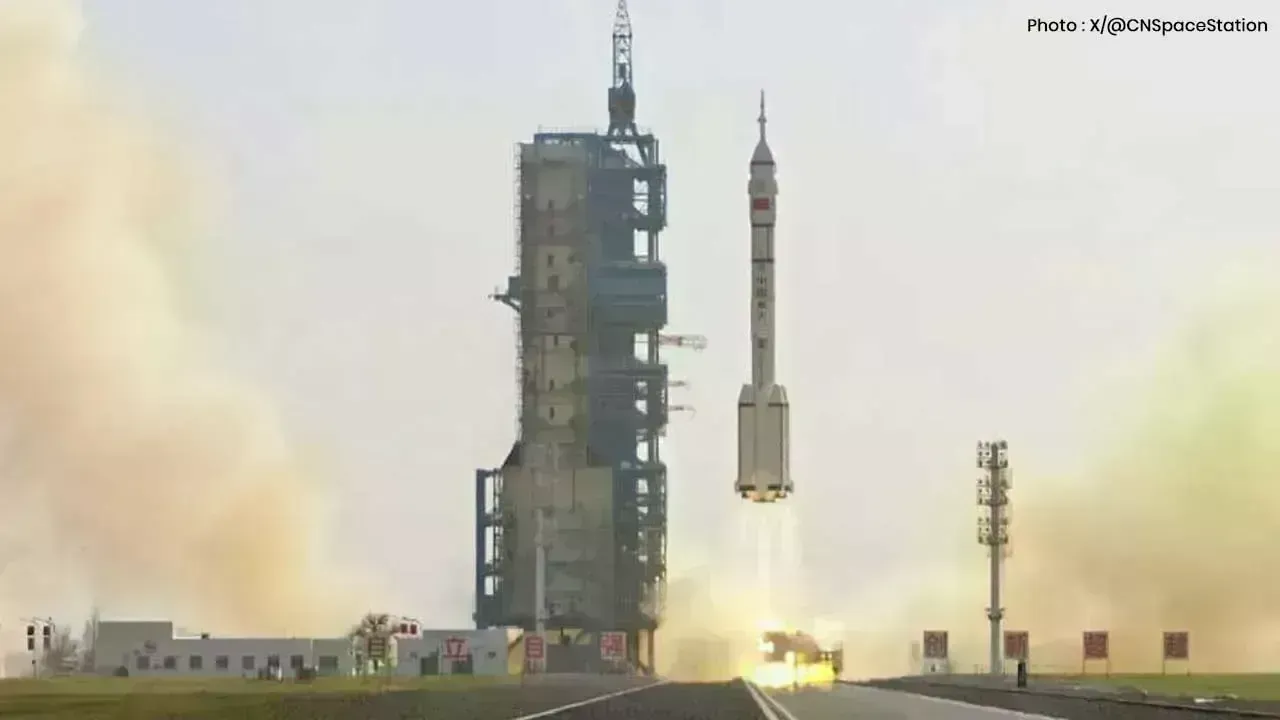
On Tuesday, China marked a significant milestone with its inaugural emergency space launch, responding to critical safety issues at the Tiangong space station. The Shenzhou-22, an unmanned spacecraft, ascended at 12:11 pm from the Jiuquan Satellite Launch Centre using a Long March-2F rocket. This operation was essential for the safety of three astronauts aboard the station, especially following a recent incident that jeopardized one of its crewed crafts.
The China Manned Space Agency (CMSA) confirmed the successful launch and subsequent separation of Shenzhou-22, which is now set to dock with the Tiangong space station, China's premier orbital facility. The station currently hosts three astronauts, who previously lacked a critical flight-ready return vehicle, posing a significant risk in emergencies.
The urgency for this mission arose due to damage sustained by the Shenzhou-20, intended for an early November crew return. A crack in the return capsule's window was suspected to result from collision with space debris, making the vehicle ineffective for flight and mandating prompt action from space officials.
In light of this, China expedited the arrival of Shenzhou-21 to the Tiangong station in mid-November, introducing a new crew. However, this left the pre-existing crew without an established emergency evacuation option, spurring the Shenzhou-22 launch.
Carrying essential supplies, the new spacecraft includes spare parts aimed at mending the Shenzhou-20's window, alongside fresh produce and crucial equipment for the astronauts' extended stay. Shenzhou-22 is projected to remain connected to the station until April 2026, facilitating a safe return for the Shenzhou-21 crew.
China's prompt response has showcased remarkable operational capability, with the CMSA preparing and launching Shenzhou-22 in just 16 days post-issue identification—a feat made possible by maintaining backup spacecraft and rockets ready for deployment at Jiuquan. Official He Yuanjun highlighted this launch as a historical first in China's space narrative and expressed hope against future emergencies.
This efficient handling juxtaposes with the experiences of other space agencies; for instance, NASA astronauts remained on the International Space Station for nine months due to issues with their return vehicle, underscoring the merits of China's proactive precautions.
Since 2021, China’s Shenzhou missions have routinely transported trios of astronauts to Tiangong for half-year rotations. Emphasizing safety, the program ensures a standby carrier rocket and spacecraft at all times to rapidly address emergencies.
The successful execution of this emergency mission not only secured the well-being of the astronauts in orbit but also showcased China’s advancing space exploration and crisis management capabilities. This operation further solidifies China's ambitions, including aspirations to land astronauts on the moon by 2030 and broaden its space endeavors.
In summary, the Shenzhou-22 launch was a crucial maneuver to mitigate an unforeseen safety issue at the Tiangong station, guaranteeing astronauts have a dependable return option and essential resources while enhancing China’s proficiency in emergency situations as it develops its human spaceflight agenda.


 English