Post by : Bianca
Haleem
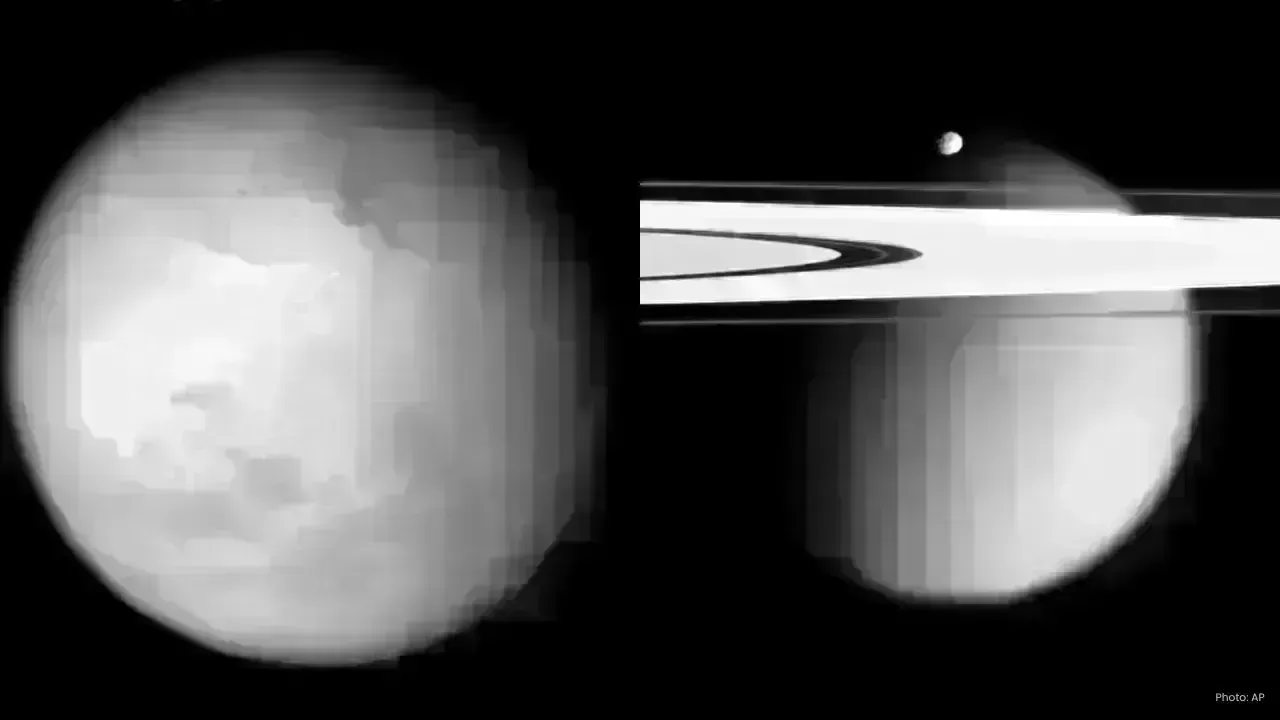
Recent research is prompting scientists to reevaluate what lies beneath Titan’s icy exterior, Saturn’s largest moon. Previously thought to harbor a vast global ocean, a new study from NASA’s Jet Propulsion Laboratory (JPL) presents a different scenario.
Instead of an extensive ocean, researchers propose that Titan comprises substantial layers of ice interspersed with slush and pockets of liquid water. This configuration might resemble partially melted ice found near Earth's poles rather than a deep global ocean. Interestingly, these findings enhance the possibility of life, despite the lack of direct evidence.
The Importance of Titan in the Search for Extraterrestrial Life
As the second largest moon in the solar system, Titan spans about 3,200 miles (5,150 kilometers) in diameter, making it slightly smaller than Jupiter's Ganymede. Its surface exhibits extremely low temperatures with lakes and rivers composed of liquid methane. The moon’s unique atmosphere and complex chemistry render it a focal point in the quest for life beyond our planet.
This research doesn’t suggest that Titan is devoid of life; rather, it indicates a different environmental setting that could facilitate the survival of microscopic life forms. Baptiste Journaux from the University of Washington, a contributor to the study, emphasizes that the near-melting underground conditions could render Titan more hospitable to life than previously believed, with nature often defying expectations.
Key Findings from the Study
The research team examined archived data from NASA’s Cassini spacecraft, which orbited Saturn from 2004 to 2017 and collected vast datasets before its mission concluded with a dive into Saturn’s atmosphere.
Utilizing advanced modeling and processing techniques, scientists reassessed the Cassini findings. They discovered that Titan’s interior responds to Saturn’s strong gravity in a manner indicating that it is not entirely fluid. If there were a large ocean, the surface would behave differently under gravitational influences, but they observed a 15-hour delay.
This unexpected delay suggests an interior composed of layered structures:
-
A robust ice crust approximately 100 miles (170 kilometers) thick
-
Thick slushy ice layers beneath
-
Pockets of liquid water even deeper
Overall, these layers may extend to over 340 miles (550 kilometers) deep, with deep-water temperatures potentially reaching a surprising 68°F (20°C)—notably warm for a moon so distant from the Sun.
Understanding Surface Dynamics
Titan is tidally locked to Saturn, meaning it perpetually presents one face to the planet, akin to how our Moon always shows the same side to Earth. As a result, Saturn’s gravity exerts a continuous pull on Titan, leading to its surface stretching and bulging.
During its closest approach in orbit, Titan's surface can elevate by up to 30 feet (10 meters). The timing of this surface movement was integral to the researchers' conclusions. The observed delayed response indicates a slushy interior rather than a freely flowing ocean.
Ongoing Debate
This study has sparked some contention. Not all scientists agree with the new interpretation. Luciano Iess from Sapienza University of Rome, who previously suggested an underground ocean based on Cassini data, believes the new evidence doesn't convincingly negate the ocean hypothesis.
This discussion highlights the complexity surrounding Titan, as scientists lack direct access to its surface, relying instead on indirect evidence that can yield varying interpretations.
Future Exploration Prospects
NASA’s upcoming Dragonfly mission, slated for launch later in the decade, may yield more conclusive insights. This innovative robotic helicopter will explore Titan's surface and atmosphere, collect samples, and investigate underground conditions.
The Dragonfly mission may address pivotal questions, including:
-
Is Titan's interior largely frozen?
-
Are liquid water pockets prevalent?
-
Could life survive within those pockets?
-
How has Titan's interior evolved over time?
Answers to these crucial inquiries may redefine our understanding of habitable regions beyond Earth.
Titan's Significance in Broader Research
Titan represents only one of many icy bodies in the solar system believed to harbor water and potentially support life.
Examples include:
-
Ganymede, Jupiter’s largest moon
-
Europa, known for its subsurface ocean and fractured surface
-
Enceladus, famous for its water geysers
With 274 confirmed moons, Saturn is a significant area for investigating potentially habitable environments.
The Relevance of Water in Cosmic Exploration
The presence of liquid water is central to discussions of life in the cosmos. Earth's extreme environments—polar ice caps, deep sea vents, and geothermal springs—harbor microorganisms. If Titan hosts warm water pockets enveloped in ice and methane, the essential conditions for life might be fulfilled.
Researchers note that any potential life forms on Titan would probably be microscopic and vastly different from terrestrial organisms. However, the notion of life persisting in such a frigid and remote environment demonstrates nature's remarkable adaptability.
Future Investigations
As ongoing analyses and new explorations unfold, our comprehension of Titan continues to progress. This fresh study doesn’t entirely discount the presence of an underground ocean; rather, it opens up new avenues of possibility, affirming that Titan remains a compelling candidate in the search for extraterrestrial life.


 English