Post by : Saif
Al-Najjar
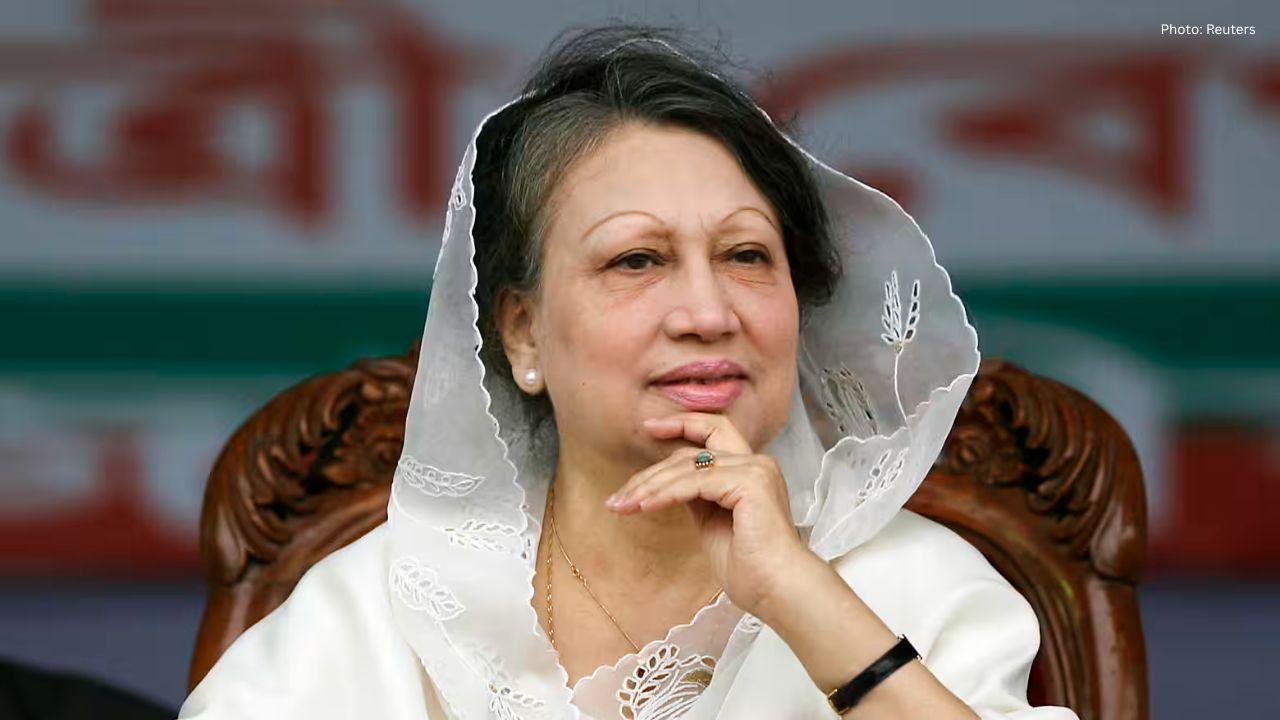
Khaleda Zia, known as Bangladesh’s first female prime minister and a significant political leader, passed away on Tuesday at 80 after a prolonged battle with illness. Her party, the Bangladesh Nationalist Party (BNP), confirmed her demise, stating she faced multiple health challenges, including severe liver disease, diabetes, arthritis, and heart issues.
Earlier in 2025, she traveled to London for advanced medical care, spending several months receiving treatment before returning home. Although she had not been in office since 2006, Khaleda Zia's influence in national politics remained strong, with considerable loyalty from her supporters.
Khaleda entered the political arena following personal loss. Initially devoted to family until the assassination of her husband, President Ziaur Rahman, in 1981 during a military coup, she took the reins of the BNP three years later, striving to fulfill her husband's vision of economic advancement for Bangladesh.
In the late 1980s, she teamed up with Sheikh Hasina of the Awami League to fight against military ruler Hossain Mohammad Ershad, a collaboration that reinstated democracy in 1990. However, their alliance soon deteriorated, leading to a fierce competition that dominated Bangladesh’s political landscape for over thirty years, earning them the nickname “the battling Begums.”
In 1991, Khaleda Zia guided the BNP to a significant electoral victory, marking Bangladesh’s first genuinely free election. As the first female prime minister, she reinstated parliamentary governance, reduced presidential powers, embraced foreign investment, and made primary education compulsory and free.
She lost her position in the 1996 elections but returned in 2001 with a robust mandate. Yet her second term faced significant obstacles, including the surge of Islamist radicals and widespread corruption allegations. A deadly grenade attack on a 2004 political rally heightened tensions and impacted the political scenery considerably.
The political upheaval led to an army-backed interim government in 2006, where both Khaleda Zia and Sheikh Hasina were jailed on corruption charges for nearly a year. Though released later, Khaleda never regained power, and her party boycotted several elections, facing years of legal battles and house arrest.
In 2018, she was convicted of corruption linked to an orphanage trust, a judgment she deemed politically motivated. As her health deteriorated, she was shifted from prison to house arrest in 2020. Finally freed in August 2024 after mass protests led to Sheikh Hasina’s ousting, Khaleda was cleared of the corruption charges with her son, Tarique Rahman, in early 2025 by the Supreme Court.
Despite her declining health, Khaleda Zia’s impact remained. The BNP is still a dominant political player, and her son is viewed as a formidable contender in upcoming elections. Her passing occurs at a pivotal time, as Bangladesh is now under interim governance led by Nobel Peace Prize laureate Muhammad Yunus.
Khaleda Zia leaves behind a complex legacy. Supporters remember her as a graceful yet resilient leader advocating democracy and national pride, while critics associate her with a politically tumultuous era characterized by division. Nonetheless, there is no denying that she profoundly influenced Bangladesh’s political narrative and paved the way for female leadership at the highest levels.


 English