Post by : Saif
Al-Najjar
India has risen to the forefront as the world’s largest rice producer and exporter, a feat heralded by trade officials and agricultural experts. In the last decade, the nation has almost doubled its rice shipping volume, reaching over 20 million metric tons in the most recent financial year. This remarkable achievement has bolstered India’s role in global food markets. However, this success is overshadowed by a looming crisis endangering farmers, water resources, and the sustainability of agriculture.
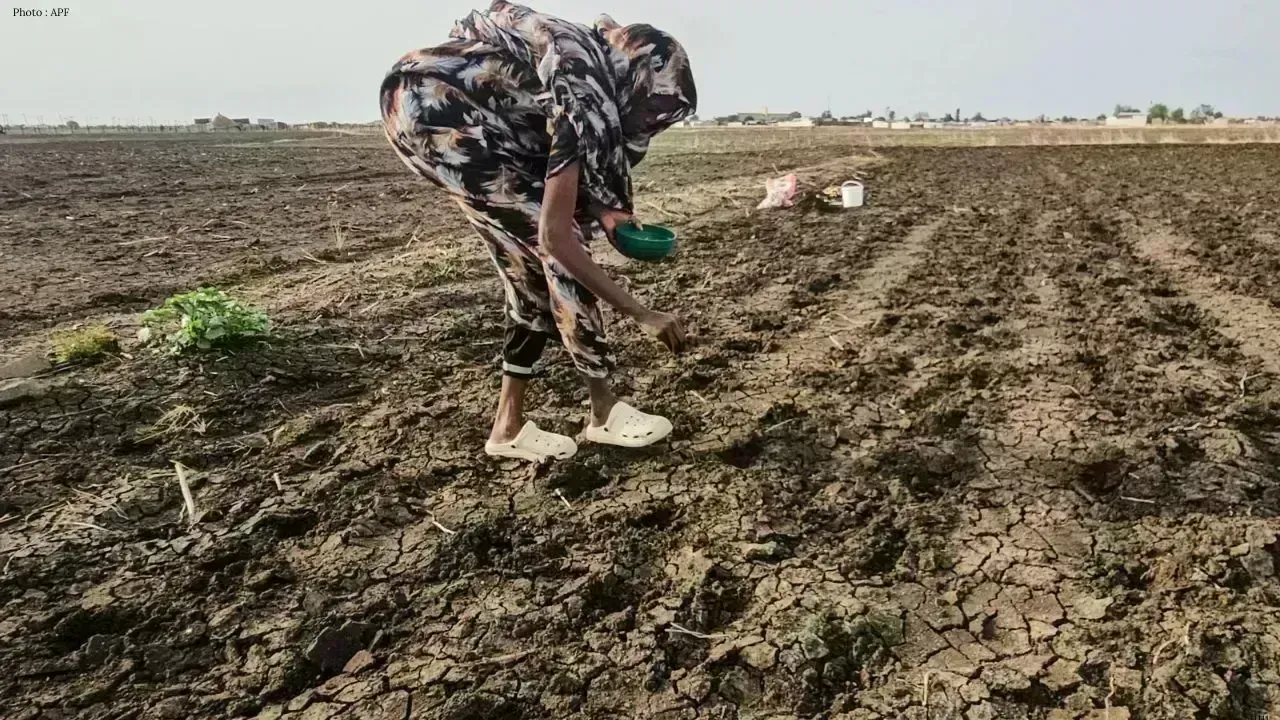
The core of the issue is water scarcity. Rice, being one of the most water-intensive crops globally, heavily relies on groundwater in India, particularly in northern regions such as Punjab and Haryana. These areas are already among the most water-stressed in the country, and the expansion of rice farming is leading to dangerously low groundwater levels.
Farmers report that just a decade ago, water could be accessed at around 30 feet; now, borewells often must go as deep as 80 to 200 feet to find it. As a result, drilling deeper incurs greater costs for farmers, including expenses for longer pipes, more powerful pumps, and additional electricity. Many find these growing costs increasingly unbearable.
Balkar Singh, a farmer from Haryana, explains, “Each year brings more expenses. The borewell just has to go deeper.” His testimony mirrors the plight faced by thousands of farmers across the region.
Government policies have significantly shaped this situation. For many years, India promoted rice farming to secure food for its growing populace. To assist farmers, the government established guaranteed minimum prices and offered substantial subsidies for electricity and fertilizers. While these initiatives once supported national food security, they now inadvertently encourage cultivation in water-scarce regions.
The repercussions are concerning. As one of the most water-stressed nations globally, India is effectively incentivizing farmers to deplete groundwater resources. Producing a single kilogram of rice may require between 3,000 and 4,000 liters of water, significantly higher than the global average.
Data from government sources reveals that Punjab and Haryana are extracting far more groundwater annually than can be naturally replenished. In some areas, the extraction rates exceed natural recharge by 35% to 57%. Consequently, substantial portions of these states have been classified as “over-exploited” or “critical” concerning groundwater usage.
Not all farmers are equally affected. Larger landowners can often adapt by investing in deeper borewells and leveraging subsidy systems. In contrast, smallholders face immediate and profound impacts, with rising costs significantly straining their minimal earnings. Many worry that if groundwater levels continue to drop, they will soon be unable to sustain agriculture.
This issue has global significance as well. With India accounting for approximately 40% of global rice exports, any significant fluctuations in its production could send ripples through worldwide food prices and supply chains. Experts are questioning whether India should continue its high levels of rice production and exportation, given the substantial environmental impact.
Some initial changes are underway, as certain state governments are promoting the cultivation of less water-intensive crops like millets. Haryana, for instance, has introduced cash incentives for farmers transitioning away from rice. Millets require considerably less water and are gaining traction as nutritious food alternatives.
Nevertheless, these measures are still limited. The current incentives are short-lived and have not yet convinced many farmers to make enduring changes. Experts emphasize the need for long-term support, transparent pricing guarantees, and assured government purchases for farmers to confidently switch crops.
Economists suggest that existing subsidies could be repurposed rather than increasing spending. Funds allocated for rice-related energy and fertilizer subsidies could instead bolster farmers cultivating less water-dependent crops, protecting farmer incomes while conserving groundwater.
A number of farmers express openness to change. Gurmeet Singh, a rice farmer in Punjab, shares that farmers would consider growing different crops if provided with adequate governmental support. “The land here is fertile,” he notes. “We are prepared to switch, provided the government buys our produce at fair prices.”
While India's rise in rice exports brings pride and global stature, it simultaneously unveils a severe environmental dilemma. Without strategic policy modifications and long-term vision, the nation risks draining its agricultural vitality. Striking a balance among food security, farmer welfare, and water preservation will pose a significant challenge for India in the coming years.


 English