Post by : Anis
Al-Rashid
A Landmark Occasion in India’s Democratic Framework
On January 26, 2026, India will celebrate its 77th Republic Day, marking the day when the Constitution of India was implemented, solidifying the nation as a sovereign democratic republic. This significant annual event features grand parades, military displays, vibrant cultural performances, and expressions of patriotism across every corner of the country. Republic Day plays a crucial role in reinforcing the collective aspirations outlined in the Constitution, reflecting an ongoing commitment to democracy, justice, liberty, equality, and fraternity.
In contrast to Independence Day, which marks freedom from colonial rule on August 15, Republic Day commemorates the adoption of the Constitution in 1950, laying down India’s governance structure and institutional identity. Since its first celebration, Republic Day has evolved into a symbol of India’s dedication to constitutional values and its stature as the world's largest democracy.
Why 2026 Marks the 77th Celebration
Counting the Anniversaries
A common query each year centers around whether the celebration in 2026 is the 77th or 78th. The distinction hinges on the origin of the count, starting with January 26, 1950, the day the Constitution went into effect. This foundational event is recorded as the first Republic Day. Counting from there, 2026 will indicate the 77th observance of this day.
Confusion often emerges when individuals mistakenly begin their count from a subsequent year or use simple calendar arithmetic without considering that the counting starts from the first Republic Day, not a “zero year.” Thus, 2026 marks 77 years since the Constitution's implementation, establishing it as the 77th Republic Day.
The Historical Background of Republic Day
Transition from Independence to Constitutional Governance
The roots of India’s Republic Day stretch back to events that transpired over several years. Following Independence on August 15, 1947, India initially lacked a permanent constitutional framework, functioning under the colonial Government of India Act, 1935.
The necessity for a self-governing legal framework led to the formation of a Constituent Assembly, spearheaded by Dr B.R. Ambedkar, which spent almost three years crafting a Constitution that reflects India's diverse democratic aspirations.
After rigorous discussions and revisions, the Constitution was adopted on November 26, 1949, coming into effect on January 26, 1950, specifically chosen to honor the Purna Swaraj Declaration of 1930, which marked the assertion for complete independence.
Constitutional Governance and Republic Day
On January 26, 1950, India transitioned from a dominion status in the British Commonwealth to a sovereign republic under a constitution crafted by its people. Key milestones of this day include:
-
Dr Rajendra Prasad's Inauguration: He became the first President of India.
-
Formation of Sovereign Legislature: The Constituent Assembly was transformed into India’s Parliament.
-
End of Colonial Governance: The colonial Government of India Act, 1935, was replaced, heralding a new era of democratic governance.
Therefore, Republic Day is not merely a celebration of a date; it is a homage to India’s constitutional identity and democratic ethos.
Republic Day 2026: Themes and Symbolism
Unity, Diversity, and Progress
The themes of Republic Day underscore India’s aspirations and priorities. For the year 2026, while the official focus is on ‘Vande Mataram’ and ‘Aatmanirbhar Bharat’ (self-reliant India), broader concepts like national unity, economic fortitude, technological advancement, and cultural diversity resonate throughout the festivities.
The occasion serves as a stage for showcasing India’s accomplishments in areas like defense, space exploration, infrastructure, and digital innovations, mixing tradition with a vision for a sustainable, equitable future.
Diplomatic Guests and Engagements
Republic Day carries diplomatic significance as well. In 2026, esteemed figures such as the European Council President and the European Commission President are anticipated as chief guests, symbolizing India’s reinforced global relationships and strategic alliances.
This aspect of Republic Day reflects its importance not only as a national celebration but also as a platform that highlights India’s international collaboration and progress.
The Republic Day Parade: National Pride in Action
Kartavya Path: Tradition and Evolution
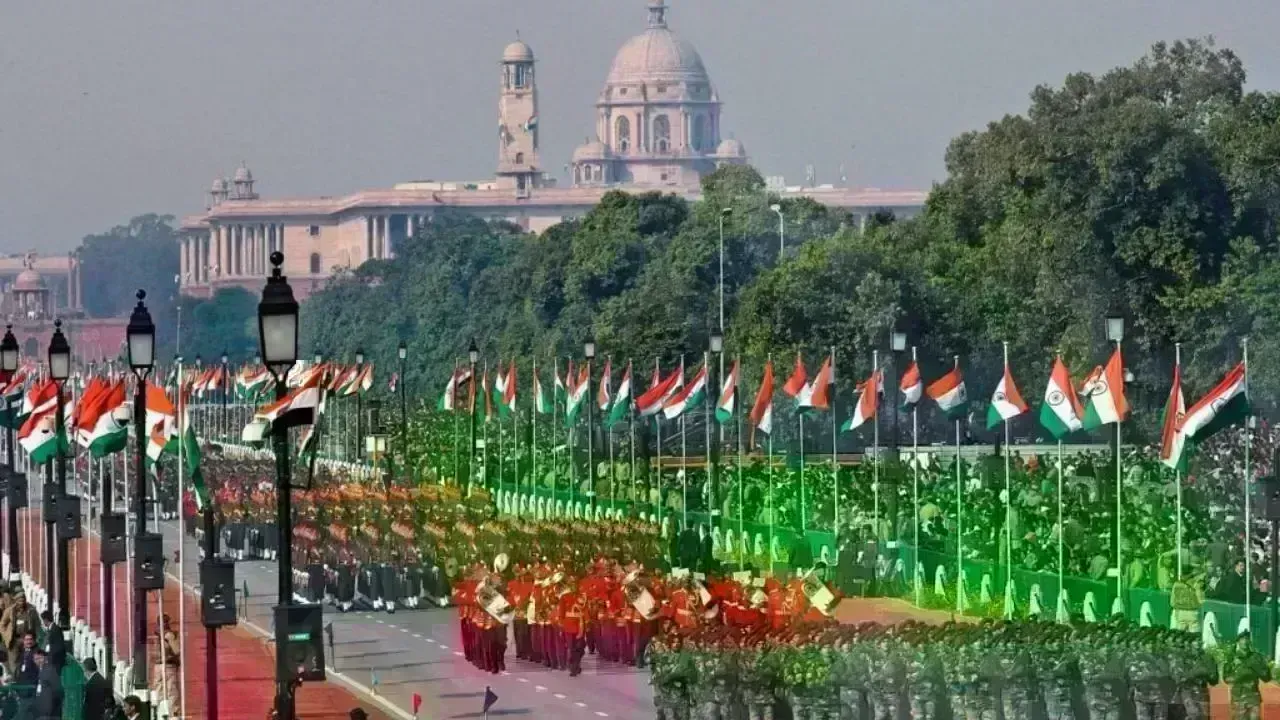
The Republic Day Parade is perhaps the most iconic moment of the celebrations. Set along Kartavya Path (historically known as Rajpath) in New Delhi, the parade runs from Rashtrapati Bhavan to the Red Fort.
Each year’s parade is a carefully coordinated spectacle featuring:
-
Military Formations: Showcasing the strength of armed forces.
-
Cultural Tableaux: Representing the diversity of states and ministries.
-
Marching Bands: Providing musical accompaniment to the procession.
-
Aerial Displays: Highlighting India’s aviation prowess with aerial formations.
Features of the Parade
-
Flag Hoisting and Presidential Address: The President raises the Tri-Colour and speaks to the nation, invoking constitutional values.
-
Showcase of Military Strength: Armed forces display their equipment and capabilities.
-
Cultural Showcases: Diverse artistic expressions of community values.
-
Aerial Demonstrations: Precision flying by the Indian Air Force, often in national flag colors.
-
Recognition and Awards: The day also features the presentation of Padma Awards and other honors.
The parade culminates in a profound celebration of Indian culture, reaffirming commitment to democratic ideals.
Public Participation and Nationwide Celebrations
Flag Hoisting Across the Nation
Beyond the capital, Republic Day is honored throughout India with flag-hoisting ceremonies in educational institutions and municipal bodies. Citizens participate with pride while the national anthem is sung, and tributes are made to the ideals of those who fought for freedom.
Cultural Events and Educational Initiatives
The day also serves as a platform for events promoting patriotism and social unity. Schools organize debates and activities that instill constitutional values in youth, while local governments hold events that celebrate regional cultures within the national framework.
Security and Logistics for 2026
Enhanced Security Measures
The scale of the Republic Day observance necessitates stringent security protocols to ensure the safety and smooth execution of events. Authorities implement multi-layered security arrangements including surveillance and crowd management tactics.
Travel & Transport Guidelines
Expecting large crowds, authorities will issue travel advisories, particularly around Indira Gandhi International Airport, to manage potential disruptions during the celebrations.
Public cooperation is vital for ensuring safety and a seamless celebration, with requests for early arrivals and adherence to security protocols.
Republic Day in Modern Discourse
Republic Day also finds a place in popular culture and social media. Patriotic narratives, historical reviews, and images from parades create a vibrant online atmosphere. Quotes, poems, and tributes become part of national reminiscence, emphasizing the unity and diversity of voices across regions.
Through varied expressions of nationalism, Republic Day transforms into a shared cultural phenomenon that spans linguistic and regional divides.
Conclusion: The 77th Republic Day's Importance
The observance of Republic Day 2026 signifies an important milestone in India’s 77th year of adopting its Constitution. It reflects nearly eight decades of growth and governance that have transitioned India from its colonial past to a vibrant republic. The festivities encapsulate ideals of democracy, cultural richness, national solidarity, and a forward-looking vision.
As the nation celebrates under the Tricolor, engages in parades, and reflects on its cultural heritage, Republic Day stands as a powerful reminder of India's enduring spirit—a celebration that resonates in ideals of freedom, justice, and equity for all.
Disclaimer:
The above content provides an in-depth overview of India’s Republic Day 2026, focusing on historical context and celebration dynamics. This information serves educational purposes and shouldn’t be considered as official government communication.


 English