Post by : Anis
Al-Rashid
In a landmark achievement, India and the European Union (EU) have successfully concluded a comprehensive Free Trade Agreement (FTA) during the 16th India-EU Summit held on 27 January 2026. This momentous agreement, hailed as the “mother of all trade deals,” marks a pivotal shift in their bilateral relationship, promising substantial outcomes for trade, investment, and global diplomacy.
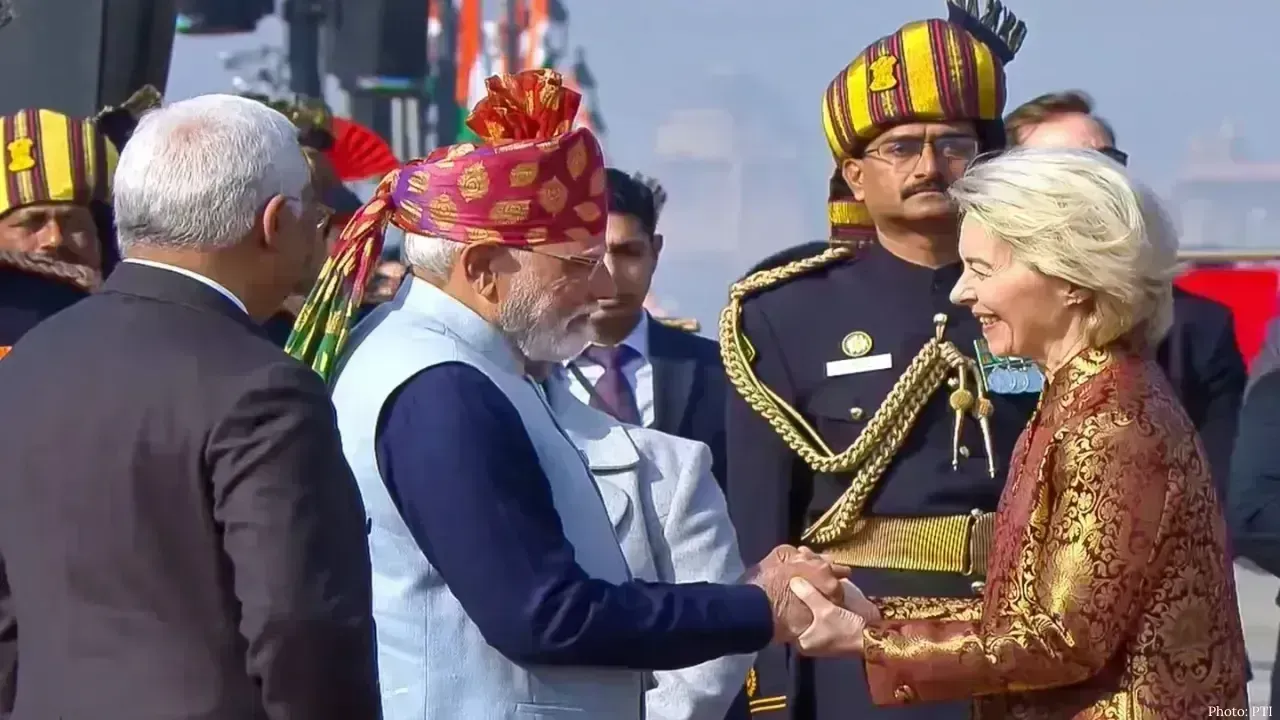
The summit, co-chaired by Prime Minister Narendra Modi, European Commission President Ursula von der Leyen, and European Council President Antonio Costa, convened in New Delhi amidst reinforced ties, underscored by prominent participation in the 77th Republic Day celebrations just one day prior.
This article delves into the achievements of the summit, the critical elements of the agreement, market reactions, and its broader implications.
Context: Economic and Strategic Ties Between India and the EU
A Historical Perspective on Trade Relations
The relationship between India and the EU is rooted in years of diplomatic and economic collaboration. Although talks for the free trade agreement commenced in 2007, progress had been inconsistent until a renewed focus in the early 2020s.
By 2024–25, the total trade in goods between India and the EU had soared to around $136.5 billion, establishing the EU as India’s top merchandise trading partner. Indian exports—comprising textiles, machinery, and services—have seen significant increases, while EU goods exported to India range from machinery to transport equipment.
Both parties have broadened their cooperation across various fields, including technology, climate initiatives, and defense, reflected in a new Strategic EU-India Agenda aimed at strengthening ties.
Key Features of the Groundbreaking Free Trade Agreement
Ending Two Decades of Negotiations
After nearly 20 years of discussions, India and the EU have finalized a comprehensive FTA, with officials confirming its announcement during the India-EU Summit on 27 January 2026.
Characterized as balanced and forward-thinking, the agreement is set to encompass trade in goods, services, and investment, alongside commitments to lower tariffs and enhance market access for exporters from both regions.
Significant Tariff Reductions
The FTA's core feature is the major cut in import duties. India has pledged to significantly reduce tariffs on various EU imports, while the EU is expected to grant duty-free or preferential entry for Indian goods, especially in labor-intensive sectors like textiles and electronics.
Currently, the average EU duty on Indian imports stands at 3.8 percent, while some categories face tariffs as high as 10 percent. The weighted average tariff imposed by India on EU goods is approximately 9.3 percent, with much steeper rates in sectors such as automobiles. This FTA seeks to diminish these barriers, unlocking export potential.
For instance, tariffs on EU automobile imports—which range between 70–110 percent—are anticipated to decrease under the new agreement, aiming for single-digit levels, benefiting European manufacturers and enhancing options for Indian consumers.
Impact on Economies: Prospects for Export Growth
Enhancing Indian Exports and Market Connectivity
Analysts predict that the India-EU trade agreement will stimulate economic activity significantly on both sides. Initial forecasts suggest Indian exports to the EU could surge by $3–5 billion shortly, building on the existing export volume of about $76 billion in 2024–25.
This growth is particularly crucial for labor-intensive sectors, as they stand to benefit from reduced tariffs and simplified regulations. A wider geographical spread of export markets can help Indian firms navigate current global protectionist trends.
Investors responded positively, with notable gains in stocks for sectors such as textiles and seafood, indicating anticipation of greater access to European markets.
Strategic Considerations Beyond Trade
Expanding the Partnership Vision
In addition to trade, the summit highlighted vital areas of strategic collaboration, including defense, technology, and clean energy. These initiatives reflect shared interests that transcend commerce, with India and the EU poised to strengthen their global collaborative efforts.
Officials are exploring the establishment of a Security and Defence Partnership to enhance cooperation in defense and interoperability—an essential advance in aligning geopolitical stances.
Additionally, the summit facilitated discussions on global governance, climate leadership, and regional stability, particularly in the Indo-Pacific, which requires extensive collaboration.
Geopolitical Context and Global Implications
Tackling Protectionism
The India-EU Free Trade Agreement emerges amidst a backdrop of global economic volatility and increasing trade barriers in various economies. European leaders emphasize that the deal represents a broader political stance against tariffs and promotes a rules-based trade environment.
European Council President Antonio Costa noted that the agreement strengthens economic ties and underscores a commitment to stability and collaborative global engagement in the face of rising unilateral measures elsewhere.
Strategic Trade Diversification
This historic FTA exemplifies India's resolve to broaden its trade partnerships beyond traditional allies. In recent years, New Delhi has sought agreements with multiple regions while balancing its geopolitical interests.
The India-EU pact—complementing deals with nations such as the UK, Oman, and New Zealand—highlights India's determination to integrate more thoroughly into global trade, lessen reliance on singular markets, and ensure robust access to European investments, technologies, and capital.
Implementation Phases and Regulatory Approvals
Future Processes and Ratification
Even though negotiations have concluded and the agreement announced, several procedural steps remain before it can take effect:
-
In India, the deal awaits approval from the Union Cabinet and parliamentary processes.
-
In the EU, it requires ratification by the European Parliament, following established legislative processes.
Consequently, the formal signing is projected to occur later in 2026, with implementation phases expected to commence in 2027, pending the fulfillment of legal and legislative requirements.
Market Reactions and Industry Responses
Stock Market Signals and Corporate Responses
Market participants quickly reacted to developments from the trade summit, especially sectors poised to benefit from tariff relaxation. Shares for exporters in textiles and seafood experienced significant increases, indicative of investor optimism regarding imminent business opportunities.
Industry groups welcomed the agreement, outlining its potential for greater integration into global supply chains and enhanced competitiveness in European markets. Analysts remarked on the deal’s balanced structure, which includes safeguards for sensitive sectors, offering potential for sustainable growth without adversely affecting domestic industries.
Looking Forward: Long-term Impact
Framework for Economic Integration
The India-EU Free Trade Agreement marks a transformative moment in one of the world's key economic relationships. By dismantling trade barriers, enhancing investment flows, and promoting strategic collaboration, the pact sets the groundwork for enduring economic engagement with significant global outcomes.
The long-term efficacy of the deal will depend on proper implementation, ongoing diplomatic efforts, and adaptability to an evolving global economic landscape.
Together, India and the EU, encompassing nearly 20 percent of global trade and about a quarter of the world’s population, have created a framework for mutual prosperity capable of shaping economic trends for years to come.
Disclaimer:
This article is for informational purposes only and does not constitute financial, legal, or policy advice. The content reflects developments and expert analysis available at the time of writing and is subject to change as formal procedures progress.


 English