Post by : Anis
Al-Rashid
A Groundbreaking Development in Research Efficiency
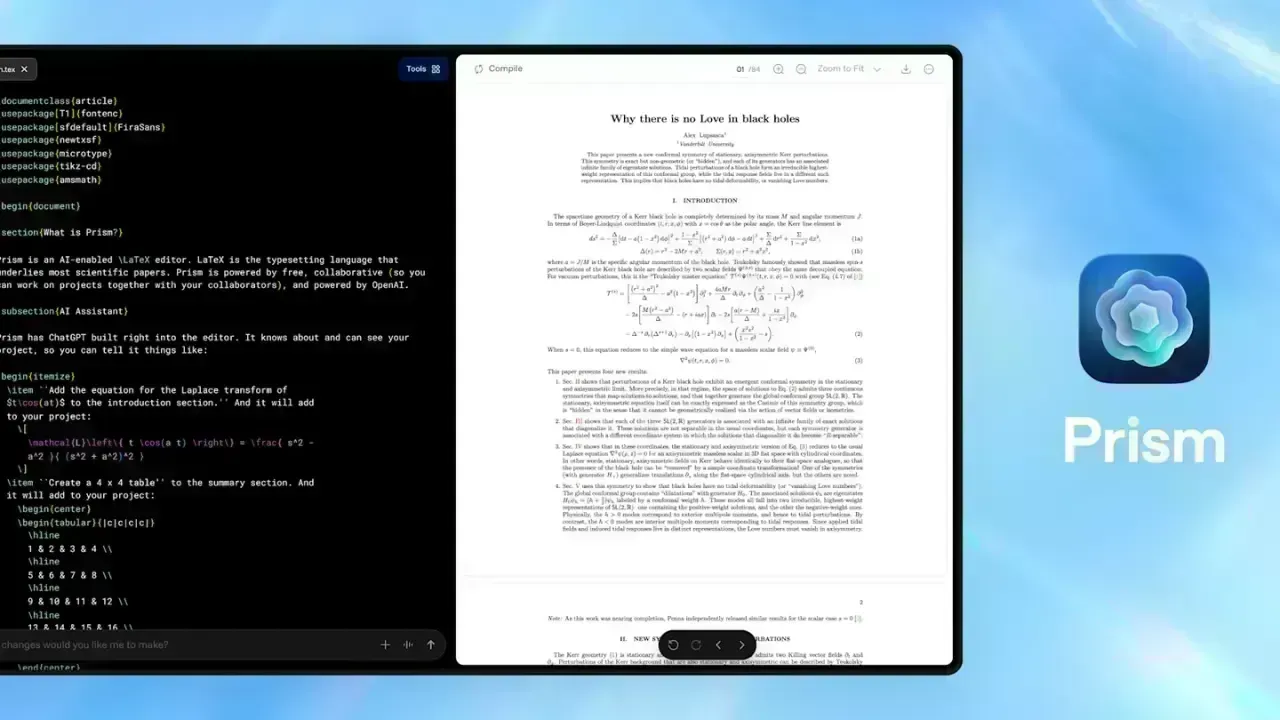
OpenAI has unveiled Prism, an advanced AI workspace crafted for scientific writing and collaboration. This platform, described as AI-native, marks a transformative phase for researchers in drafting, refining, and coordinating academic content—especially for papers and manuscripts. Utilizing the sophisticated GPT-5.2 model, Prism offers deep reasoning and LaTeX integration, setting the stage for a complete overhaul of scientific workflows by merging drafting, citation management, collaborative efforts, and AI assistance into one seamless environment.
In contrast to conventional research tools that compartmentalize various research phases—be it writing, citation, or version management—Prism integrates these elements into a cloud-centric workspace accessible from anywhere. Its primary aim is to minimize complications caused by switching platforms or engaging in manual formatting, issues that often hinder productivity in scientific writing. Now available to anyone with a personal ChatGPT account and later to institutional users, Prism is provided free of charge with no limits on collaborators or projects, ensuring that researchers at every career stage can utilize its capabilities.
Challenges in Scientific Writing and Teamwork
Scientific processes have traditionally faced fragmentation, leading many researchers to report spending excessive time on citation alignment, document formatting, and collaboration efforts rather than focusing on their actual work. The process of drafting research papers often requires navigating through various tools such as version control systems, reference managers, and text editors, making the overall experience cumbersome. Despite the availability of specialized tools, their inability to seamlessly integrate adds complexity and reduces efficiency for research teams.
Scientific articles typically undergo numerous revisions across different teams, often scattered across various locations and time zones. Problems like real-time editing, change tracking, and version management remain prevalent challenges. Additionally, creating complex elements like equations, tables, and citations with conventional tools can consume vast amounts of precious time. This situation highlights the need for AI-driven solutions like Prism that aim to streamline essential aspects of scientific collaboration.
How Prism Functions
At its core, Prism is a cloud-based LaTeX workspace marrying sophisticated AI tools with the established structure of scientific documentation. LaTeX is favored in STEM disciplines for its effective handling of equations and formatting, making it vital for drafting academic pieces. Prism incorporates these LaTeX functionalities into the cloud while adding AI features that understand contextual nuances in active manuscripts.
One of Prism's most compelling features is its AI-enhanced drafting and revision capabilities. Leveraging GPT-5.2, users can receive assistance with summarizing portions, clarifying language, identifying citation gaps, converting handwritten formulas to LaTeX, and suggesting structural enhancements. The AI also aids in idea exploration, complex reasoning, and responding dynamically to user input.
With a project-aware AI engine, Prism comprehends the entire history of a document, permitting coherent suggestions and context-sensitive editing. For instance, while refining specific sections, the AI can connect to earlier parts of the paper, minimizing the need for exhaustive manual checks for content consistency.
Real-Time Collaboration: Unlimited Team Members and Projects
A standout aspect of Prism is its facilitation of unlimited co-authors, allowing diverse research teams to collaborate in real-time without restrictions. This capability resolves a critical challenge in collaborative research, where traditional editing and sharing practices can create access limitations or version control difficulties. Communication is enhanced as collaborators can view edits and comments live, ensuring all team members engage with the latest document version simultaneously.
Supporting unlimited projects and collaborators gives research teams the flexibility they need across various disciplines and locations. Graduate students, senior researchers, and external reviewers can all participate in the writing process without the common burdens associated with licensing. Ultimately, Prism aims to democratize research tools, fostering more inclusive collaboration.
Integrating LaTeX: Enhancing Scientific Formatting with AI
LaTeX is the preferred format for precise scientific typesetting due to its detailed content formatting and ability to manage intricate mathematical expressions. Prism's comprehensive integration with LaTeX—embedded within the workspace—eliminates the need for separate LaTeX setups, facilitating seamless compilation and previewing without the usual delays associated with conventional LaTeX platforms.
Beyond essential LaTeX support, Prism also provides automated citation management, error-checking, and equation conversions, significantly easing researchers' workloads. The AI undertakes formatting checks and corrections as part of the drafting experience, ensuring that the rigors of LaTeX formatting do not impede usability for less experienced users.
Beyond Just Writing: Aiding Research and Reasoning
While Prism primarily focuses on text editing and formatting, its AI capabilities far exceed basic writing tasks. Researchers can leverage the platform to refine arguments, validate logical structures, clarify hypotheses, and even conduct literature searches—all within the same workspace. Unlike traditional editors, Prism’s AI grasps the semantic context of scientific arguments, delivering suggestions that resonate with the broader narrative of the document.
This integration allows users to seamlessly discover pertinent literature and references, streamlining the traditionally arduous task of citation integration. Moreover, Prism’s reasoning abilities empower scientists to investigate ideas and assess conceptual ties—such as juxtaposing different models or verifying logical continuity.
Making Research Tools Accessible
OpenAI has positioned Prism to cater to a diverse user base, granting access to students, independent researchers, and even seasoned scientists through a simple ChatGPT personal account. This accessibility is designed to break down barriers created by paywalls and institutional licenses. By offering early access, Prism brings equal opportunities to smaller or underfunded teams, providing essential scientific writing tools typically reserved for those with financial resources.
OpenAI has also announced plans for organizational access—including business and education plans—that will extend Prism’s features to broader groups, facilitating institutional adoption. The platform is designed to cater to individual creativity and large-scale collaboration, appealing to various academic professionals.
Impact on Scientific Research and Academia
Prism arrives amidst a growing trend of AI tools shaping scientific research, publication practices, and interdisciplinary teamwork. As the volume of global research grows, the demand for tools that alleviate manuscript preparation barriers escalates. Academic publishers and research institutions may find Prism’s integrated workspace invaluable, particularly as it minimizes the need for multiple software systems.
In addition to streamlining manuscript creation, Prism’s analytical features could expedite hypothesis refinement, potentially reducing the cycle time from experimentation to publication. By alleviating redundant tasks, scientists can direct their focus toward critical intellectual challenges and innovative concepts.
Addressing Criticism and Future Developments
Like any pioneering tool, Prism faces scrutiny regarding its capabilities. Although it facilitates writing and formatting tasks efficiently, some experts assert that it cannot replace the in-depth analytical processes central to scientific discovery. The need for researchers to engage in experimentation, data analysis, and independent judgment remains, which AI tools can assist with but not entirely substitute.
Future iterations may introduce advanced features like automated data visualization, enhanced semantic searches across vast literature, or integrations with experimental design frameworks. These advancements indicate a commitment to evolving into a comprehensive research tool that supports the entire research cycle, extending well beyond writing and formatting.
Conclusion: Embracing a New Era in AI-Enhanced Scientific Writing
OpenAI’s introduction of Prism signifies a monumental leap in integrating artificial intelligence within scientific workflows. By offering an all-inclusive space for writing, collaboration, formatting, citation management, and AI assistance—anchored by the power of GPT-5.2—Prism presents a revolutionary tool in the realm of research. Its free access and unlimited collaboration potential pave the way for a wider spectrum of researchers to contribute meaningfully to scientific advancements.
With Prism, OpenAI is not merely launching a tool; it is reshaping the norms of scientific documentation, collaboration, and innovation. As its user base grows, Prism may profoundly influence how scientific writing progresses and interconnects various disciplines.
Disclaimer: This article is based on current information available from public reporting and official announcements at the time of writing. It is provided for informational purposes only and does not constitute technical or professional advice.


 English