Post by : Sami
Al-Rahmani
Robotics and AI Reshape Manufacturing for Greater Efficiency
Manufacturing is undergoing a rapid technological shift as artificial intelligence (AI) and robotics become core elements of production. Facilities that once relied on manual processes and fixed machinery are adopting automated, data-driven systems to cut costs and improve throughput.
From automated production lines to predictive maintenance and collaborative workstations, AI and robotics are changing how products are designed, assembled and delivered. This transition represents a structural change in industrial operations rather than a simple set of incremental upgrades.
The Move to Smart Manufacturing
Where traditional industry pursued scale, modern manufacturing pursues intelligence. AI analytics, machine learning and robotic automation enable real-time decisions on the factory floor. This convergence of technologies is commonly labelled Industry 4.0, linking machines, people and data into integrated systems.
Robots as Operational Partners
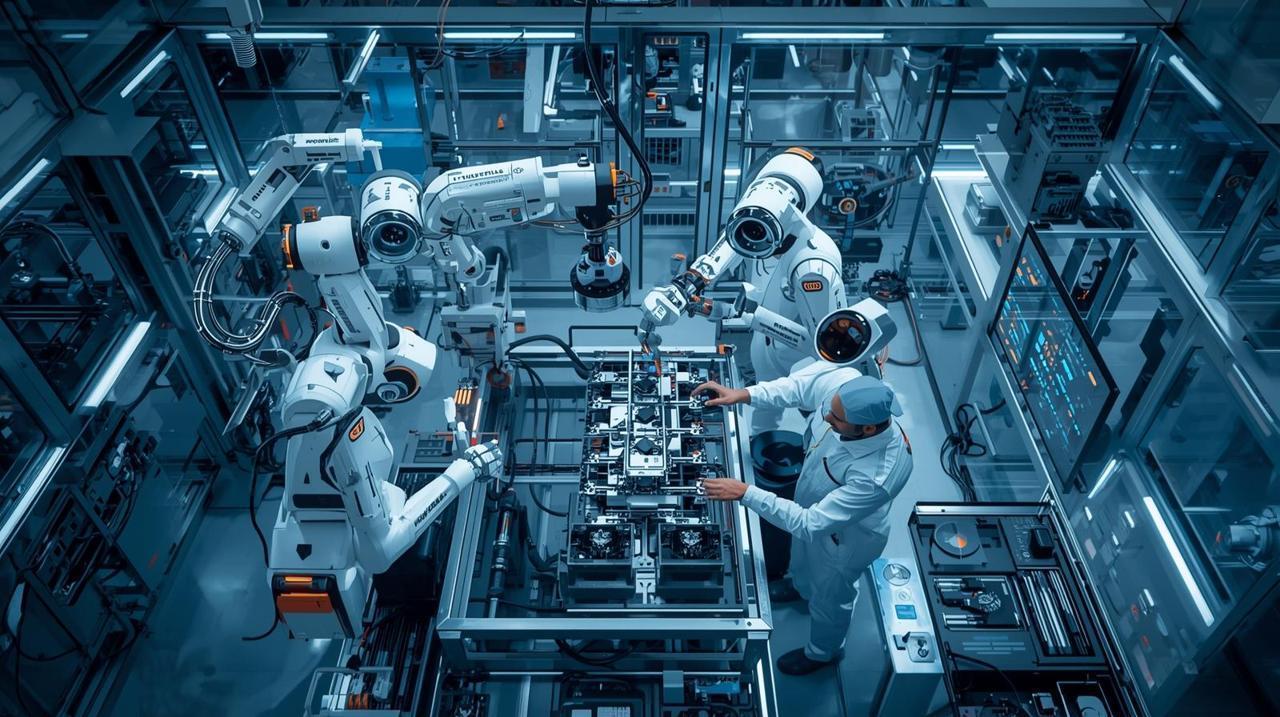
Robots have evolved beyond fixed, repetitive roles. Current systems are more adaptable, precise and safer to operate alongside human workers.
Collaborative Robots (Cobots)
Cobots are engineered to collaborate directly with staff without extensive guarding, expanding their use across varied tasks.
-
Cobots carry out precision tasks such as welding, packing and inspection.
-
They are often simple to reprogram for different operations.
-
Deployment of cobots reduces errors and can raise production speed.
Vendors like ABB, KUKA and Universal Robots have made cobots accessible to smaller and medium-sized manufacturers.
Autonomous Mobile Robots (AMRs)
AMRs use sensors and computer vision to move materials across factory and warehouse environments, improving logistics and safety.
These systems lower manual handling requirements and are widely used in high-volume operations such as Amazon’s fulfilment centres.
AI: The Decision Layer
Robots provide physical capability; AI supplies analysis and control. Machine intelligence processes large volumes of production data to spot inefficiencies, predict faults and optimise output.
1. Predictive Maintenance
Predictive maintenance identifies likely equipment failures from sensor data before breakdowns occur.
-
This lowers unplanned downtime.
-
Enables proactive maintenance scheduling.
-
Extends equipment service life.
Research by McKinsey indicates AI-driven predictive maintenance can cut maintenance costs by up to 25% and reduce unexpected failures by about 70%.
2. Quality Control
AI-based computer vision systems improve quality assurance by detecting defects at scales and speeds beyond human inspection.
Sectors such as semiconductors, automotive and pharmaceuticals rely on these systems to meet strict quality standards and avoid costly recalls.
3. Supply Chain Optimization
AI increases visibility across the supply chain, helping companies:
-
Forecast demand with better accuracy.
-
Manage inventory dynamically.
-
Improve routing and logistics efficiency.
These capabilities reduce waste, speed deliveries and strengthen supply-chain resilience.
Human and Machine Cooperation
Automation is expanding but not fully replacing people. The effective model pairs machines with human skills—machines take on repetitive or hazardous work while staff focus on oversight, problem-solving and optimisation.
Firms that invest in training and upskilling to operate alongside intelligent equipment report gains in productivity and innovation. Simulation tools and targeted training programmes help close the skills gap.
Data as a Production Asset
Modern facilities produce vast volumes of data from sensors and systems. AI turns that data into actionable insight, enabling prompt operational adjustments.
Common uses include:
-
Automated scheduling of production.
-
Identification of bottlenecks.
-
Lowered energy consumption through smarter control.
As data accumulates, systems become more adaptive and continuously improve performance.
3D Printing and AI
The pairing of 3D printing and AI is enabling bespoke, optimised component manufacture. AI aids in design adjustments to produce lighter, stronger parts with less waste.
Industries such as aerospace, automotive and healthcare are adopting these methods to make customised parts faster and more economically.
Sustainability Gains
AI and robotics also support more sustainable production through:
-
Energy monitoring and reduction.
-
Precision use of materials by robots.
-
Lower emissions via optimised logistics.
For example, Siemens applies AI-driven energy management across its sites to cut carbon output, demonstrating that efficiency and environmental goals can align.
Challenges to Adoption
Despite clear benefits, adoption faces obstacles:
-
High upfront costs for smaller operators.
-
Cybersecurity vulnerabilities in connected systems.
-
Concerns over job displacement.
-
Shortage of skills in AI, data science and robotics maintenance.
Governments and industry are responding with training initiatives and partnerships to broaden access and reduce barriers to implementation.
Global Trajectory
Countries including Germany, Japan, South Korea and China are at the forefront of smart manufacturing. Initiatives in nations like India and the UAE also aim to attract technology investment under Industry 4.0 frameworks.
Major manufacturers such as Tesla, Foxconn and Bosch illustrate how AI and robotics can expand output while preserving quality. Analysts project the global smart manufacturing market could exceed $800 billion by 2030, driven by ongoing automation and AI integration.
Outlook: Toward Autonomous Facilities
The long-term direction points to increasingly autonomous factories where AI coordinates production with limited human intervention.
Potential features include:
-
Automatic demand forecasting and output adjustment.
-
Continuous, automated assembly, inspection and packaging processes.
-
Real-time supplier interaction driven by algorithms.
Advances in AI, robotics, IoT and 5G make this scenario progressively more feasible.
Conclusion
AI and robotics are reshaping manufacturing into smarter, safer and more efficient operations. While cost, security and skills remain challenges, the benefits in productivity and sustainability are significant.
As firms and governments invest in technology and workforce development, AI-powered smart factories are set to play an increasingly central role in global industry.
The manufacturing sector is evolving rapidly—driven by automation, data and intelligent systems.


 English