Post by : Anis
Al-Rashid
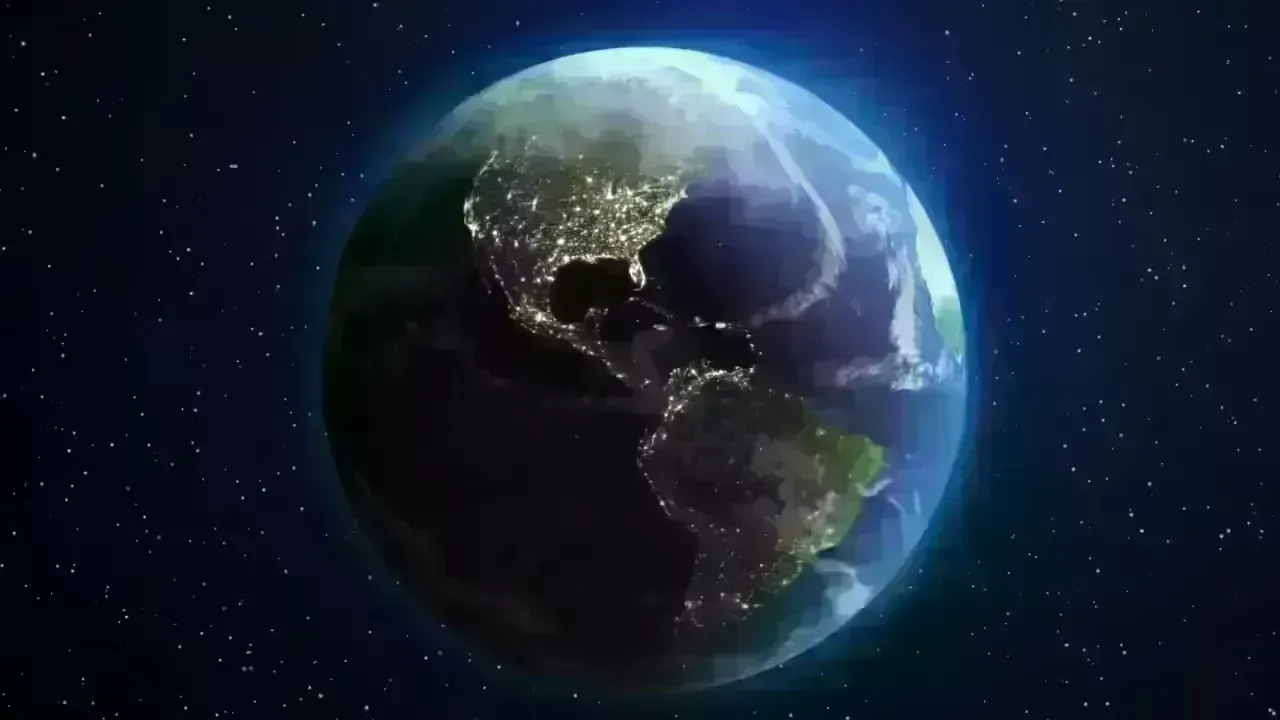
The notion of Earth halting its spin seems like a tale plucked from science fiction. Imagination often conjures catastrophic visions of individuals catapulted into the void, while oceans crash across landmasses, or one hemisphere freezing as the other scorches. Although some notions hold a semblance of truth, the actual fallout from Earth ceasing its rotation is remarkably intricate, unsettling, and rooted in scientific principles.
Earth's rotation is vital to existence, woven so deeply into our routines that we often overlook it. Despite feeling still, the planet spins at an astonishing 1,670 kilometres per hour at the equator. This motion governs gravity, climate patterns, ocean behavior, ecosystems, and even human physiology. Remove this dynamism, and the Earth as we know it would transform into a completely alien landscape.
This piece delves into the real implications of Earth's rotation coming to a halt—whether abruptly or gradually—and reveals why many anticipated dangers might not be as perilous as they seem.
The Integral Role of Earth's Spin
Earth's rotation is crucial, far beyond simply creating day and night. It subtly impacts the very nature of gravity. Thanks to the planet’s spin, centrifugal force momentarily offsets gravity, particularly at the equator. This results in Earth being an oblate spheroid, bulging slightly at its waist.
A cessation of rotation would see gravity start to mold the planet into a more spherical form. Such a transition would redraw coastlines, inundate countries, and modify the equilibrium between land and sea.
Rotation also orchestrates the Coriolis effect, steering winds and ocean currents. Its absence would cause a collapse of global circulation systems, instigating widespread climatic failures.
Immediate Impacts of a Sudden Stop
An instant halt of Earth’s rotation would unleash inertia as the planet’s greatest adversary. Everything on its surface—air, water, structures, and living beings—would continue moving eastward at rotational speeds.
At the equator, that velocity surpasses that of many aircraft, leading to catastrophic global repercussions:
Oceans would rush east, spawning astronomical tsunamis
The atmosphere would produce supersonic winds
Cities would be annihilated through kinetic energy
Forests would be leveled on a monumental scale
Such a disaster would unfold within mere minutes.
Yet, this severe scenario hinges on an instant stop, an unlikely reality. A more stimulating inquiry is what occurs if Earth gradually decelerates its spin.
Consequences of a Slowdown
A gradual reduction in spin avoids immediate catastrophe but still wreaks long-term devastation.
Days and Nights Redefined
Currently, Earth rotates once every 24 hours. As it slows down:
Eventually, Earth could become tidally locked, trapping one hemisphere in permanent sunlight while the other experiences eternal darkness, akin to the Moon’s alignment with Earth.
Life would no longer engage with “days;” instead, it would face varying hemispheres of illumination and shadow.
Weather Systems Would Collapse
Weather depends on uneven heating and rotation. Remove rotation, and atmospheric structures transform dramatically.
Instead of multiple wind cells and jet streams, we would see a singular massive convection system:
Air would rise on the sunlit side
Move at high altitudes to the shadowed side
Sink into perpetual chill
Descend near the surface
This transformation would yield constant megastorms near the light-dark divide, with winds surpassing any recorded hurricane.
Some regions would experience relentless rain, while others would remain parched.
Changes in the Oceans
Earth's oceans are currently unevenly distributed due to rotation causing water to bulge at the equator. Without spin, this bulge dissipates.
Water would shift towards the poles, unveiling vast equatorial dry land while submerging polar areas under kilometers of ocean.
The resulting geography would feature:
Dry equatorial supercontinents
Deep, submerged polar oceans
Devastated coastal ecosystems
Extinction of coral reefs and fisheries
Marine life would face mass extinction due to shifts in pressure, temperature, and oxygen availability.
The Decline of the Magnetic Field
Earth's magnetic field arises from molten iron movements in its outer core, a process influenced by planetary rotation.
As rotation decreases, the geodynamo weakens. Over geological time:
The magnetic field may collapse
Solar radiation would bombard the atmosphere directly
Atmospheric particles could be swept away
Radiation exposure would rise significantly
This change wouldn’t be immediate, but gradually Earth could start resembling Mars: cold, arid, and exposed.
Intense Evolutionary Pressures on Life
While life wouldn’t vanish in a gradual slowdown scenario, survival would necessitate significant adaptation.
In the Light
Extreme warmth
Unending solar exposure
Severe dehydration
Limited biodiversity
Life might take refuge underground or evolve into forms that resist radiation.
In the Dark
Only extremophiles—organisms surviving in hostile environments—might endure.
The Twilight Zone
The narrow strip between light and dark would become the most suitable habitat. Life would concentrate here, similar to ecosystems around deep-sea hydrothermal vents today.
Human Civilization's Demise
Modern societies rely on:
Each of these depends on Earth's rotation.
Agriculture would collapse due to unpredictable seasons. Infrastructure would fail under climatic pressures. Migration challenges would become overwhelming.
Even advanced technologies couldn't sustain billions in such conditions.
The Impossibility of a Natural Stop
Earth is unlikely to randomly halt its spin. Angular momentum preserves its rotation. Stopping it would necessitate a force so immense it could obliterate the planet entirely.
Only events like:
A colossal planetary impact
A close encounter with a rogue celestial entity
Interference by a stellar force
could significantly alter Earth’s rotation. All such scenarios would pose extinction-level threats before any spin cessation could occur.
A Misunderstanding: Gravity's Nature
One of the prevailing myths is that stopping Earth's spin would annihilate gravity. This misconception is incorrect.
Gravity derives from mass, not motion. Even without rotation, Earth would maintain nearly the same gravitational force.
The primary change would be how gravity is experienced, particularly at the equator where centrifugal force currently diminishes part of gravitational pull. Humans would weigh slightly more, but this concern pales in comparison to the planet’s broader issues.
What This Hypothetical Scenario Teaches Us
This thought experiment isn't about predicting disaster, but about appreciating Earth's delicate equilibrium.
Rotation impacts:
Earth is more than merely a rock in space—it forms a finely tuned system where motion equates to life.
Essential Insight: The Miracle of Stability
The most astonishing realization isn’t the chaos that would ensue from Earth's spin ceasing, but how critically it must continue for life to thrive.
A slightly quicker rotation would amplify storms, while a slower pace would disrupt climate. Earth resides within an exceptionally narrow bandwidth where complex life flourishes.
This equilibrium is easily overlooked—until one envisions its absence.
A Final Reflection
Should Earth stop spinning, it wouldn’t culminate in individuals flinging into space or darkness descending instantly. Instead, it would unravel the unseen mechanisms that quietly foster life.
The genuine peril isn’t the spectacle but the collapse of systems.
Earth spins not merely to gift us day and night, but to nourish oceans, shield the atmosphere, regulate climate, and sustain every organism that inhabits it. Though Earth would continue to exist, it would no longer be a liveable world.
Disclaimer:
This article serves informational and educational purposes solely. The outlined scenario is speculative, lacking realistic propositions of planetary events.


 English