Post by : Bianca
Haleem
Iran-backed Houthi rebels in Yemen said they carried out missile and drone attacks on Saudi Arabia's Abha International Airport on Monday. The group said the operation was a direct response to airstrikes that hit Sanaa International Airport earlier the same day, which they blamed on Saudi Arabia.
No casualties were reported from the attacks. However, the exchange marked one of the most significant escalations between the two sides since Saudi-led coalition forces last targeted Houthi-controlled areas several years ago. Saudi Arabian officials did not immediately comment on the reported strikes inside Yemen.
Houthi Warning to Airlines
Houthi military spokesperson Brig. Gen. Yahya Saree released a video statement on Telegram following the attack. He warned airlines against using Saudi airspace and said the warning should be taken seriously until what he described as the blockade on Sanaa International Airport is lifted.
Earlier on Monday, Saree also accused Saudi Arabia of ending a period of "de-escalation" by launching airstrikes. He said the attacks would not go unanswered and described the strike on Sanaa airport as an attempt to stop humanitarian flights carrying patients and stranded civilians.
Yemeni Government Explains Airport Strike
The internationally recognized government of Yemen said the strike on Sanaa International Airport was carried out to prevent an Iranian aircraft from landing.
Later, Yemen's Defense Minister, Gen. Taher al-Aqili, said in a post on X that the airport runway had been targeted to stop an Iranian plane carrying a Houthi delegation from returning to Yemen after attending the funeral of Iran's Supreme Leader Ayatollah Ali Khamenei in Tehran.
Read More: Missiles Fired by Houthis at Saudi Arabia, Breaking Four-Year Calm
Before the strike, al-Aqili released a video statement warning against Iranian aircraft entering Yemeni airspace. He said Yemen's patience had run out and that authorities would respond to what he called hostile aircraft violating the country's sovereignty.
The Houthis said the Iranian aircraft was instead diverted to Hodeida Airport, where it landed safely.
Saudi Coalition Responds
Saudi-led coalition spokesperson Maj. Gen. Turki al-Malki said on X that Saudi air defense systems intercepted ballistic missiles launched by the Houthis toward the kingdom's southern region. He did not provide additional operational details.
Airports Closed Following Escalation
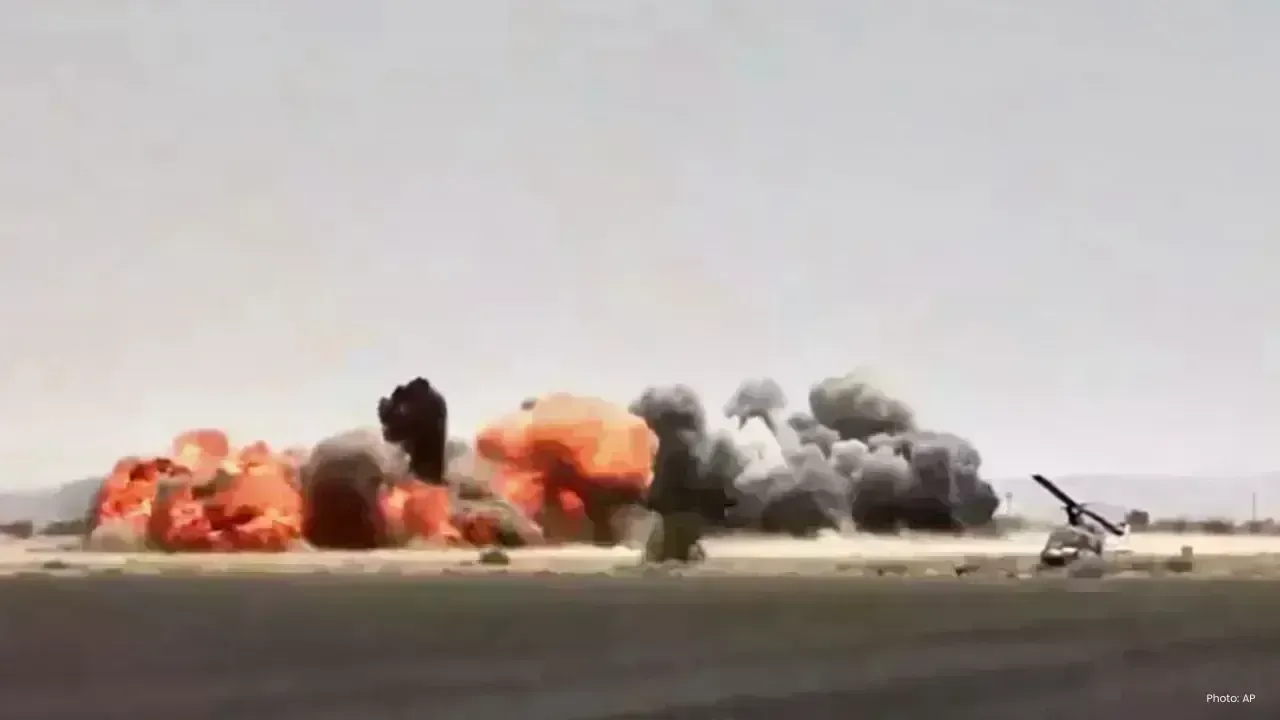
Video broadcast by the Houthi-run al-Masirah television channel appeared to show a missile hitting a runway at Sanaa International Airport, followed by a large explosion.
Following the incident, Yemen's government announced that all airports in the country would remain closed until further notice. The Yemeni Defense Ministry also ordered the evacuation of the airport and nearby areas.
Rashad al-Alimi, chairman of Yemen's Presidential Leadership Council, said Iran had requested permission for a Mahan Air flight from Tehran to Sanaa to transport the Houthi delegation back to Yemen.
According to the council, the request was rejected because it did not follow the country's legal and sovereign civil aviation procedures. The statement added that the Houthis insisted on receiving the Iranian flight outside those legal frameworks.
United Nations Calls for Restraint
The United Nations Security Council held an emergency meeting on Monday to discuss the latest developments.
U.N. Assistant Secretary-General for Political Affairs Khaled Khiari warned that further escalation could threaten both Yemen and the wider region. "Yemen and the wider region cannot afford another cycle of escalation," Khiari told the 15-member Security Council. "We call on all actors to constructively engage in negotiations under UN auspices."
Hans Grundberg, the U.N. Special Envoy for Yemen, also said his office was closely monitoring developments in Yemeni airspace. He expressed concern over the growing tensions and urged all parties to engage in dialogue to preserve the relative calm Yemen has experienced since 2022.
Background of the Yemen Conflict
Yemen's civil war began in 2014 after the Houthis seized the capital, Sanaa, along with much of northern Yemen, forcing the internationally recognized government into exile.
A Saudi-led coalition, supported by the United Arab Emirates, entered the conflict in 2015 with the aim of restoring the government. Earlier this year, tensions increased between Saudi Arabia and the UAE, leading to the UAE ending its involvement in Yemen.
The latest confrontation follows rising tensions earlier this month, when the Houthis accused Saudi aircraft of violating Yemeni airspace in an attempt to prevent an Iranian plane carrying a Houthi delegation from traveling to Tehran for the funeral of Ayatollah Ali Khamenei.
Houthi-controlled areas had not faced Saudi-led coalition strikes since a United Nations-brokered ceasefire came into effect in 2022.


 English